America’s Worst Idea
Like many, I have been enjoying Ken Burns’ The National Parks, America’s Best Idea. I found the fifth episode especially interesting. Among the artists profiled was Chiura Obata, a painter, Berkeley resident, art teacher at the University of California, and a victim of the harsh treatment of Japanese people during World War II. I discovered Obata’s story during a visit to the de Young Museum in San Francisco in late December 2000. The museum building was going to be demolished so that a new earthquake-resistant facility could be constructed. The old de Young had been damaged by the Loma Prieta earthquake, and the collection was at considerable risk.
One of the final shows at the de Young was of the Quaker painter Edward Hicks, known for his Peaceable Kingdom paintings. This inspired some Friends at Berkeley Meeting to organize a group visit to the museum to view the exhibit. Some of us from other local meetings accepted their invitation to join them.
The show was worth the visit, but another Friend had an idea of not stopping there. He asked me to join him in a walk to the Obata exhibit in another room. I am glad I did. We saw the Yosemite paintings that were shown on the Burns’ documentary. Most striking were the sketches he drew of the internment camp he was forced to call home in Topaz, UT. A letter from Eleanor Roosevelt thanked him for the painting he had sent her.
Many Bay Area Japanese were relocated in World War II, including busloads of Berkeley residents. I sought out the address on Ellsworth Street that was listed on the documents, but, alas, Obata’s house has been since replaced with an apartment building.
Just the week before, I was reminded of the Obata story when I saw another documentary about a homeless, Japanese artist in New York during 9/11, the Cats of Mirikitani. Jimmy Mirikitani was living on the streets and painting pictures of cats just a few blocks from the World Trade Center. After the towers fell, a film editor invited him to stay temporarily with her while she helped him find shelter. She ended up making the documentary as he told her of his life, including his internment at Tule Lake. The film makes a power statement of how we treat those different from ourselves. Back then, Japanese people were the villains. Today, it is the Muslim people. In the film, Mirikitani sadly shook his head, knowing how little has changed.
I did not think much about the treatment of Japanese in World War II until my adoption by Tadashi and Alice Yamaguchi in 1969. Tad said his family was sent to live in a camp along the Colorado River when he was a boy. His parents, who came to the United States when they were very young, lost everything they owned, including their farm in Cucamonga. What happened to these citizens is inexcusable. If parks like Yosemite and Yellowstone are America’s best idea, camps like Topaz and Tule Lake* were our worst.
* To that worst list I should add the reservations where our government shipped our native peoples after stealing their land.
Jim Carroll and a concert to (almost) die for.
It was sad to hear the news that Jim Carroll died of a heart attack on Friday, (9/11) at age 60. I didn’t hear of it until I turned on Alex Bennett on Sirius Satellite Radio this morning (9/14). Carroll had been on Bennett’s New York radio show as a poet in the 1970s, then as a rock star in San Francisco in the 1980s. I first heard Jim Carroll in 1978 at one of the most bizarre concerts I have ever attended. It turned out to be Carroll’s first rock performance when he opened for the Patti Smith Group.
My ex-wife and I were big fans of Patti Smith, starting with the release of her album Horses. When we heard she would be coming to the California Theater in San Diego in May 1978, I went out an bought tickets well in advance of the show. When we arrived at the theater, I was in total shock. The stagehands union had decided to strike the theater for hiring a non-union crew and had set up a picket line in front of the theater. Being the son of a union carpenter, crossing a picket line to me was a serious offense, even worse than voting Republican. I remember being disappointed as a teenager that I couldn’t go to the newly built Sea World because of a boycott called by the Carpenter’s Union. (I later ended that personal boycott by taking by daughters there. I have also voted since then for a few Republicans.) I decided to cross the line since we already had the tickets and spent our money. I found myself crossing another stagehand’s picket line to see Tom Robinson at an old movie theater in Pacific Beach. As with Patti Smith, I had bought the tickets in advance.
When the show started, Smith announced that the opening act had canceled and brought out Carroll for a performance of poetry back by rock music. There is very little I remember from that night. I found some references to the concert via Google search, including this link to an actual recording of the concert.
http://www.bigozine2.com/archive/ARrarities06/ARpssandiego.html
But wait, as they say, there’s more! A year before, Patti Smith had fallen off a stage during a concert in Tampa, breaking several vertebrae in her neck. During the San Diego concert she decided the best way to avoid another injury was to allow fans to stand directly under the stage. This way, human bodies would be there to break her fall.
The decision to have a bunch of people jammed up at the stage did not sit well with the fire marshal. He threatened to shut down the concert. This did not sit well with the audience. Panic ensued with Smith rushing on and off stage while her band stood there perplexed. Without their singer, the band decided to play the best they could without her. Finally, Smith came back to the mike and announced she had reached a compromise. The concert would go on if the aisles remained clear. At this time everyone was on their feet, and I was fearing a stampede. This was before the Who’s Cincinnati Concert where a stampede caused the deaths of eleven concert attenders.
Smith came down the aisles and cleared them herself, telling everyone to get back to their seats. The concert did continue, but I was still in shock from feeling very close to being trampled to death.
This was not my only near death experience. As a kid, I almost drowned in the Atlantic Ocean. So far, it is my most exciting. To be a part of rock history! And in San Diego, of all places! Goodbye, Jim Carroll. This post is for you my brother.
Email thanking Senator Feinstein for supporting public option
http://feinstein.senate.gov/public/index.cfm?FuseAction=NewsRoom.PressReleases&ContentRecord_id=628d7b3c-5056-8059-7604-3fd88e116f6c&Region_id=&Issue_id=
Email to Senator Feinstein:
At the recommendation of friends, I read your August 28 press release, Concerns Regarding Healthcare Reform, and found it very helpful. There so are so many confusing and contradictory reports on the current health care debate, it can be quite discouraging to the average person who lacks affordable, comprehensive insurance. While we worry about the cost of any plan on the nation’s deficit, I agree with the President that not doing anything will be more expensive.
I appreciate your support for the public option. I prefer that to the proposed non-profit cooperatives. Former Vermont Governor Howard Dean opposes them and said, “The co-ops are too small to compete with the big, private insurance companies. They will kill the co-ops completely by undercutting them, using their financial clout to do it. In the small states like mine and like Senator Conrad’s, you’re never gonna get to the 500,000 number signed up in the co-op that you need to in order for them to have any marketing [power].” http://thinkprogress.org/2009/06/15/dean-coop-proposal
In addition, I am concerned by your statement “Health reform should not address end of life care.” The intent of the provision for end of life care was clearly distorted by those who want to stop any reform from passing at all. Such planning should be covered so that doctors may be able to discuss all options for the benefit of both patient and family. As with the public option, we are talking about choices, being able to choose what is best for us and for our families. I would like to see more on how you would like that issue to be addressed.
Thank you for your time and effort on health care reform. Please keeping working on the behalf of us who are either uninsured or underinsured. We cannot afford to wait any longer.
Update: Email response from Senator Feinstein sent 9/15/09
Dear Mr. Yamaguchi:
Thank you for contacting me to express your support for the inclusion of a public health care option in health care reform legislation. I am committed to enacting meaningful reform to expand access to the health care system.
I am delighted that you support healthcare reform, as do I. The key is to find a healthcare plan that provides coverage, as well as limits costs. My colleagues in the Senate and I have been working on this, but it is a difficult issue and must be carefully thought out. I hope that the Senate Finance Committee will propose a bill which will lay out a way in which we can accomplish these goals and can be effectively merged with the bill passed by the Senate Committee on Health, Education, Labor, and Pensions.
Other health reforms are also necessary. I strongly believe that any healthcare reform legislation should prohibit coverage denial based on preexisting conditions. Reducing healthcare costs is absolutely essential. Between 2000 and 2007, combined profits for 10 of the country’s largest publically traded insurance companies rose 428 percent. I believe that a way to control those costs is by instituting a public option, a nonprofit cooperative model, or a regulatory authority to achieve this. I am also concerned about the astronomical growth of entitlement spending, which makes up 56 percent of all federal dollars spent in 2009. Health reform must bend the healthcare cost curve, slowing the growth of entitlements in order to reduce our nation’s debt and budget deficit.
Any Senate health reform bill must improve California’s complex health care system, and please know that I am working hard with my colleagues to make health care affordable for all Americans, without adding to the federal deficit.
Again, thank you for writing. If you have any further questions or comments, please do not hesitate to contact my Washington, D.C. office at (202) 224-3841. Best regards.
Sincerely yours,
Dianne Feinstein
United States Senator
A sketch of our yearly meeting location, Walker Creek Ranch
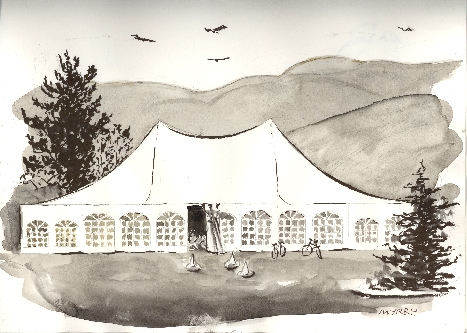
Sketch by Trudy “Myrrh” Reagan
Weighing Marriage Equality
I do not believe that those who oppose same sex marriage are necessarily homophobic. I do believe marriage equality is a civil rights issue and that fair-minded people will eventually agree that denial of marriage rights is a form of discrimination. As individual states end discrimination against same sex couples, people will realize that the institution is actually being strengthened.
Those who stand in opposition have argued that we can’t redefine marriage. Marriage they say is an institution almost as old as civilization itself and has always been between a man and a woman. If we start redefining marriage, they charge, who knows where we will end up? This is what we know as the “slippery slope” argument. Here’s how it goes: If we legalize gay marriage, what is to stop us from legalizing polygamy? What about legalizing marriage between adults and children or humans and animals?
In reality, the premise that marriage has never changed or been redefined is false. Marriage has been redefined through history and has changed with the times, and not just by expanding it to include interracial couples. It has changed as the roles of men and women in society have changed. As we have changed from an agrarian to a more industrialized society the role of the family has changed, as well. On the farm, the husband went out every day to work the fields while the wife stayed in the farmhouse and cared for the children. Now, both men and women work outside the home. Many couples choose to not have children. Marriage has changed.
Women were once considered intellectually and physically inferior to men. They were denied equal access to education. They were denied the right to own property or even vote. These barriers to sexual equality have fallen with the rise of the modern feminist movement.
I know this is shocking and offensive to say today, but there was a saying among males I knew as a teenager in the sixties. That saying was “a man can’t rape his wife.” It meant that a woman couldn’t deny her husband sex however and whenever he wanted. It was not said in polite society, but it was said in the locker rooms and bars where men would speak freely between themselves of how they saw a woman’s function in marriage. That I have not heard that thought expressed in decades indicates how much our attitudes have changed.
It was not long ago that women were considered a part of a man’s property in marriage. Some would argue that a wife was no different than a prostitute for her husband. He had paid for her keep and so had earned the right to do as he pleased with her. He brought home the bacon, and she kept him happy with a clean house, dinner on the table, a brood of happy children, and, of course, sex. This relationship was validated with Bible verses in the same way that keeping African-Americans as slaves was justified. A wife was expected to submit to her husband. The husband was the master of the house whom his wife and children were expected to obey. The Bible has been used to justify modern polygamy, but only for the purpose of allowing the male to possess multiple females.
What has changed is the relationship of power in the marriage relationship, or at least civil marriage. Woman is now equal to the man with equal rights within marriage. Husbands can no longer force their wives to have sex with them because rape is rape, period.
The jobs of housework and child raising are still not as equally divided as they should be, but that continues to change. It is not uncommon now for men to chose to stay home to raise children. Even if men are not doing an equal share of housework, they are doing more than their fathers and grandfathers did.
When I hear the word equality I think of a balanced scale. On this scale, there are two objects. They may be the similar or they may be different. Yet each has the same weight. Each is at the same level. Neither one is higher or lower in relation to the other.
If we define marriage as a relationship between two equal partners, we can refute the “slippery slope” argument. We recognize that sexual relations between adults and children are unhealthy because the relationship in power is unequal. The adult always has power over the child. Therefore marriage between adults and children is not healthy for society. The relationship between humans and animals is unequal, as well.
Polygamy should be rejected for the same reason. Where one man has multiple wives an unequal relationship of power exists. That unbalance would exist if a woman were allowed to take multiple husbands. While some advocate polyamory to advance gender equality, this arrangement does not have basic human nature in its favor. It is difficult, if not impossible, to maintain relationships of multiple partners without jealousy and favoritism coming into play.
That is the appeal I make to reasonable people. They understand what science continues to affirm. Sexual orientation is not a choice, but is biologically determined. When I was a closeted gay teenager, homosexuality was considered a psychological defect. Today, the scientific community recognizes that lesbians and gay men can have healthy, loving relationships. They are capable of raising healthy and happy children.
I do not expect these arguments to sway religious conservatives who are hostile to scientific evidence and obsessed in their opposition to gay rights. I wonder if this realignment of relations between men and women in marriage is at the root of their obsession with preventing lesbians and gays from marrying. They would have us go back to the days when the woman submitted herself to her husband and when ministers said, ” I now pronounce you man and wife.” Under that definition of marriage, the ceremony allows a man to stay a man, but the woman must change to become a wife.
Years after marriage rights have been granted to every loving couple in every state of the nation, we will look back and wonder what all the fuss was about. Perhaps we will recognize that these marriages were the result of a society that walked the path toward greater equality and social justice for all.
World’s Greatest Tweeter?
My recent Twitter post wishing a happy birthday to Ray Bradbury got me at least one follower, and she doesn’t even have naked pictures she wants to show me. It’s always nice to know someone is reading. I am reminded of my own encounter with Bradbury that I am now a bit embarrassed about. I got a chance to speak to the author when I was a nineteen-year-old student at Palomar College in Southern California. Bradbury, who has boasted of being the world’s greatest writer, was giving a lecture in the college’s geodesic dome auditorium. During the question and answer period, I told him I wanted to be the world’s greatest writer, too, and asked for advice. Bradbury laughed and told everyone, “See, there is room for more than one of us.” He then advised me to work hard, keep practicing, and expect rejection. He told me he still received rejection letters from magazines every week. Most people are lazy and give up easily, he said. Good writers do not give up and keep submitting their work until they get published.
Later, I realized his comment about sharing the claim to greatness was really saying that I should find my own niche. I gave up on writing mediocre science fiction stories and spent a couple decades trying to find that niche. I wrote essays about my environmental and political interests. I wrote humor and satire because I have loved reading great humorists and satirists like Mark Twain and Art Buchwald. I had a fair amount of success getting letters to the editor published, especially when I was involved in a small political group that advocated growth control. That was when I was living in the small town of San Marcos, where Palomar College is located.
After moving to Berkeley, I worked for a non-profit agency that assisted homeless people seeking employment. That was where I became a resume writer and learned how to write functional resumes for our clients. Functional resumes are different from chronological in that they emphasize skills over employment history. The homeless population we worked with had large gaps in their work histories. Many were making career changes, either out of choice or necessity. For them, the functional resume, as taught to us by the late Yana Parker, was the best choice for marketing themselves to employers. An example is my resume on my web site. As I worked with job seekers, I found myself really enjoying writing resumes. Needless to say, my coworkers found my attitude quite odd since they hated that part of their jobs. For me, it was an exciting opportunity to hear people’s stories, and I heard a lot of great ones. Many were not suitable for a resume, but others were after a little creativity was employed. When people saw their stories on paper, they were always thankful. Then there was the feedback that could be quantified. I knew the resumes I created were effective when people reported back that they were getting interviews. So I could say that, for a time, I did find that niche. I was the world’s greatest resume writer.
A number of people have told me I am a good writer but I have never had the confidence to attempt to make money from it. Given the current media landscape, it is getting more difficult to make writing a career, and anyone can get themselves published without worrying about editors or rejection letters. We can Twitter and Facebook. We can blog and post to listservs. We do this without an editor to tell us if what we are writing is worth publishing. We are left to become our own editors, which means we must look at our own work critically. Yet how many of us can be objective about our creations?
The fallout of the freedom to publish without restriction includes spam emails and tweets. We flame each other in newsgroups and post inappropriate comments to news stories. The web is full of so many words and so little worth reading. Yet amid all the noise, I find voices worth hearing. I will compose, revise, and revise again, hoping that the result means something to someone, somewhere.
The Eagle lands on Pomerado Road
I am probably one of the few people who doesn’t have a memory of Apollo 11 that involves television. I did not see Walter Cronkite pause at the announcement that the Eagle had landed. I had to work that night, otherwise I would have probably been glued to the tube with the rest of the world. That summer, I had just graduated from High School and was still Tom Campbell. I was living with Tad and Alice Yamaguchi in Poway, Ca. They would adopt me in the fall.
My first full time job was washing dishes at a restaurant that had just opened by the I-15 freeway in Rancho Bernardo, 5 miles away. I was nineteen, but I still did not know how to drive, so I bought an old 1-speed bicycle and rode to work. My route was north on Pomerado Road, then west on Rancho Bernardo Road. Frequently, my ride was in the middle of the night, as it was on the night of the moon landing. I brought a small transistor radio to work and tried to listen best I could. Then, when I got off work, I tied the radio to the handlebars of the bike and rode home listening to the coverage.
In those days, there was not much of anything between Poway and Rancho Bernardo along Pormerado Road. There were no houses or stores. I do remember one church somewhere between the two towns. There were no streetlights along the narrow two-lane road, and my small headlight barely kept me from riding off into the ditch. I do remember being able to see the moon that night, and a quick check of the Internet confirmed that the moon was in its first quarter on 7/20/09. Today, it seems so much like a dream as I think about riding that old bike down the road in the dark. It was so empty, I felt like I was on the moon myself. My only connections to civilization were the blacktop below me and the radio receiving the voices from that visible piece of disk high above me. When I got home, I went straight to bed. I did not need to see anymore that night. I had all the information I needed. I knew that when I looked at the moon again, it would not be the same.
an email on Berkeley bicycling
I just emailed my city council member on improving bicycle routes in Berkeley.
Dear Councilmember Darryl Moore:
As a person who uses a bicycle as my primary mode of transportation, I am continually thankful for the establishment of Berkeley’s bicycle route system, including the Bicycle Boulevard network. I have a special fondness for the Channing Way Boulevard, as I, like you, live on that street. It is my usual route to downtown Berkeley and Telegraph Avenue. The signal light at MLK Jr. Way has greatly improved my ability to safely and quickly cross that intersection.
A number of improvements have been made to Ninth Street that has made it more useful for me. One is the retiming of the signal at University Avenue that has reduced wait times. Another is the creation of the four-way stop at Dwight Way. Now, with the opening of Berkeley Bowl West, I can now ride to the signal light at Ashby Avenue. Before this route, the only other alternatives across Ashby for cyclists were at San Pablo Avenue and Seventh Street. Both of those intersections pose difficulties and dangers to cyclists. In Fact, cyclists on Seventh must quickly change lanes between two short green lights in order to continue straight into Emeryville. So getting to Murray Street is an improvement, though the signal at Ashby does not change for bicycles waiting at Ninth. Since the light changes for cars, it should not take much to improve the signal to detect for bikes.
Another dilemma exists for cyclists headed to Emeryville when they reach Murray. They must either turn left, taking them to San Pablo, or turn right, taking them to Seventh where a left turn is not permitted. Turning right on Murray actually puts them back at the hazardous intersection with Ashby. It is possible to construct a path along the old street car route that originally ran along Ninth Street. That area is unpaved and the section between Murray and Folger is currently fenced off. I do not know if this possible path is in the city’s plans for bicycle route development, but I strongly encourage the development of this path that would extend the Ninth Street Bicycle Boulevard to Emeryville’s city limits and connect with that city’s Doyle Street Bicycle Boulevard.
I would also recommend improving the intersection of Channing and San Pablo with the installation of a signal light similar to the one at MLK Jr. Way. This would allow cyclists to cross four busy lanes of traffic while discouraging drivers from using that street as an alternative to Dwight Way.
Thank you for support for bicycling in Berkeley. We know that many more people would ride if they felt safe on the streets. Bicycle boulevards give people the confidence to ride on streets where traffic is lighter and car speeds are slower. The boulevards work best when people can use them to get where they want to go, safely and easily. I believe these improvements will make these two bike boulevards more useful for riders. These improvements are to streets within the bounds of District 2. I request your support for these and other improvements to our bike boulevard network.
Thank you for your service
June 27 was designated by President Obama as a national day of service. Citizens were encouraged to go out that day and engage in some well organized, volunteer activity. I’m sorry to say I forgot to sign up. In fact, I forgot all about it until the next day. I could have volunteered for one of Obama’s service projects, but I was too busy that day helping a friend move. Service happens.
Since Barack Obama has moved into the White House, I have been reflecting on what it means to serve your country. I appreciate that Obama regards all types of service, not just military service, as valuable contributions to our nation’s health and security. Obama is not a veteran, which annoys conservatives. Of course, he is not the first Commander in Chief without military experience.
For me, it opens up another question as someone who never enlisted into the military. Can a person in civilian service be considered as noble and heroic as one who carries a gun into harm’s way? Is the community organizer fighting poverty in our nation’s cities as important to our national security as the tank driver in the Middle East? Do I have the right to say that I have served my country?
We have a number of holidays that honor those who have worn military uniforms: Memorial Day, Veterans Day, and the Fourth of July. On each of those days we honor those who have “made the ultimate sacrifice,” and, as well, we should. Those who have given their lives should be honored. Those individuals are indeed very brave. In contrast, does that make the rest of us cowards? Those of us who refuse to fight have been given that label. Yet many pacifists have been known for their unselfish dedication to humanity and some of them have made the ultimate sacrifice with their lives.
Those who served in past wars included those who did not carry guns. My father, Thomas Campbell Sr. served in World War II as a Seabee. As a carpenter, he helped build the landing strips and other facilities that allowed our troops to fight the war in the South Pacific. He told me that he was once caught in the middle of a battle on one of the construction sites. He confessed to being so scared that he shit in his pants. I replied that if people were shooting guns at me and all I had in my hand was a hammer I would shit in my pants, too.
Then, there are many veterans who never came within a thousand miles of a battlefield. They just did their jobs and returned to civilian life. Don’t we honor these veterans as much as those who saw combat? We certainly don’t call them cowards. And some of them have made the ultimate sacrifice. The civilian and military staff who went to work at the Pentagon on September 11, 2001 did not think they would be giving their lives while serving their country. Yet on that day, a number of them did.
I appreciate all the opportunities we have to serve our country and defend our democracy. One that has been valuable for me is working the polls on Election Day. Yes, we do get paid for our work, though not that much. It is mostly a labor of love. On the day of our last Presidential election, I served on a small crew at the local fire station. We busily checked in voters and directed them through the process that ensured their votes would be counted. We assisted Democrats, Republicans, Libertarians, Greens, and those with no political party at all. Each was equally important to us. Each had a vote that needed to be counted.
During the last hour that the polls were open an elderly black woman arrived with the assistance of some younger family members. We didn’t ask her age, but we were sure she was well into her eighties. She told us she had never voted before in her life, but she came down that day to vote for an African-American man for President. As she slowly filled out her ballot, others continued to file into the fire station and cast their votes. Patiently, we helped her feed her ballot through the scanner. Then, with more assistance of her family members, she slowly walked outside to return home. Our crew remained at our post until the polls officially closed.
We worked late into the night, shutting down and packing up the equipment. Then we took the completed ballots to the county election officials to be duly tabulated. Across the nation other poll workers were doing the same. We knew the election conducted in our precinct was fair because we stood as witnesses to that election. We trusted that other common citizens across the nation were also witnessing a fair and honestly conducted election. We served our country that day and defended the legitimacy of our democracy.
To all the poll workers in every national and local election, I thank you for your service.
Marriage Equality in Iowa
I have been working on my Twitter posts, trying to see how I can express a complex thought into 140 characters or less. It reminds me of E.B. White’s Satirical essay Irtnog, in which all printed material for that day is condensed into a 6 letter word. This my tweet on Iowa’s Supreme Court ruling on gay marriage:
Happy about Iowa, but violation of state constitution can be changed with constitutional amendment. Think Prop 8. LGBT need Fed Govt rights.
Since my Facebook status is set to update with my tweets, a Friend responded via Facebook:
The Iowa legislature has a Democratic majority, and the amendment process will take at least two years. It was in Iowa that a gay teen first invited his partner to the prom. When journalists descended on the small Iowa town, the principal explained that he could invite his mother if he wanted, that they had no restrictions on prom dates. Iowa has long had a mix of views. I’m not sure Iowa’s constitution would be easy to change, given how many people will see friends, coworkers, and family members marry over the next two years.
My reply to her was:
Yes, we can hope that opinion continues to shift in our favor during that period of time. My political outlook tends to be 50% optimist and 50% skeptic. I am optimistic that everything will work out, but skeptical that it will be any time soon.
I expressed my optimism in an earlier post on Proposition 8. Yes, our society is moving toward acceptance of LGBT rights as a legitimate civil rights issue. I compared the passage of Prop. 8 with the repeal of the Rumford Fair Housing law in 1964. Unfortunately, when I watched the state Supreme Court deliberate over proposition 8’s constitutinality in March, I learned the big difference between the two. The difference is federal government recoginiton of rights for racial minorities. There is no such recognition of LGBT people. Until there is, we will have to fight for equality, state by state. California is expected to uphold Prop. 8 as a legimate amending of the constitution. Eventually, all LGBT people will have their civil rights protected on the national level, though I don’t expect it to happen very soon.
-
Archives
- July 2024 (1)
- May 2023 (1)
- May 2022 (1)
- September 2021 (1)
- March 2021 (1)
- October 2020 (2)
- September 2020 (1)
- May 2020 (1)
- April 2020 (1)
- March 2020 (2)
- January 2020 (1)
- December 2019 (1)
-
Categories
-
RSS
Entries RSS
Comments RSS
 Tomyamaguchi's Weblog