Everything But Marriage, A Tale of Two States
Yes, I am disappointed that marriage equality lost at the polls again, this time in Maine, but I continue to be reluctant to equate the passage of Measure 1 with homophobia. The vote was close, but we should have won. It should have been apparent to everyone that this is a civil rights issue. Obviously, it was not. But we shouldn’t assume that everyone who voted for Measure 1 hates gay people, nor should we label Maine residents as a bunch of ignorant bigots. Yes, in the same election, voters approved a medical marijuana initiative. This is good news for people with HIV/AIDS who use the drug to stimulate their appetites and counter the side effects of chemotherapy. As an environmentalist, I am also happy to see that a measure to reduce taxes on cars was soundly defeated, but that is another issue. The fact that these votes are close is amazing, considering the size of opposition to marriage equality just a decade ago.
Meanwhile, in Washington, voters passed a liberal domestic partners initiative Referendum 71, also know as Everything But Marriage. If anything, we should be concerned about the closeness of that vote, about 52% to 48%. A look at the map of election results shows that the counties who approved the measure are clustered in the northwest area of the state, around the large population centers of Seattle and Tacoma. The more rural areas tended to reject the measure. (In Maine, Portland voters rejected Measure 1 by 73%.) It is in these rural areas where we need to do our work.
The best thing we can continue to do is be out and visible. The more people who know a friend or family member who is gay, the more likely they will become our allies. We need to build on the issues where we have majority support. We now have an anti-hate crimes law, and should soon have repeal of Don’t Ask Don’t Tell, as well as passage of a law against employment discrimination. Finally, we should treat those who disagree with us on marriage with respect. We should have answers for their concerns about the definition of marriage. I have some thoughts in a previous blog entry and welcome comments. If we can get Everything But Marriage now, we can build upon that to achieve our rights in all aspects of public life.
Smears against Jennings. Have they no shame?
The smears against Department of Education’s Kevin Jennings continue. Rep. Steve Smith has gathered 52 other Republican House representatives to sign a letter to President Obama, demanding he fire Jennings. The charge “of ignoring the sexual abuse of a child” by Jennings has been proven false, but that does not deter the letter’s signers. Their real motivation is their assertion that Jennings is “promoting homosexuality and pushing a pro-homosexual agenda in America’s schools…” They continue to lie that young people are recruited into being gay. It is the same lie directed to Governor Schwarzenegger , demanding he veto a bill honoring Harvey Milk as a civil rights pioneer. Somehow, teaching school children about the life of Milk will turn them gay. Conversely, we are asked to assume, if homosexuality is barred from the classroom, all children will grow up heterosexual. Having spent my school years in the fifties and sixties, I know that homosexuality doesn’t go away if people stay silent about it. I grew up with Dick and Jane books, where all parents were heterosexual, and, I might add, white.
When I first read about the campaign against Jennings, I sent the following e-mail to Education Secretary Arne Duncan:
Opponents of Kevin Jennings have sunk to a new low by falsely linking him to NAMBLA, a pedophilia advocacy group. In doing so they also smear Harry Hay by falsely stating Hay was a founder of NANBLA. Hay was correctly praised by Jennings as one of the pioneers of the modern gay rights movement. Hay founded the Mattachine Society and co-founded the Radical Faeries. Hay’s only connection to NAMBLA was in his support for their right to march in gay rights parades.
All of the charges thrown at Mr. Jennings have turned out to be distortions or complete lies. It is clear what is the intent of these organizations. They want to turn back the clock to a time when it was not safe to be a gay, lesbian, or transgender youth. I know from experience, growing up gay in a homophobic society. I wish I had leaders like Kevin Jennings when I was in high school. I thought of suicide in those days and am thankful I never acted on those thoughts. Sadly, too many young people have died, lacking the support of their families, schools, and communities. Our LGBT youth need organizations like GLSEN.
I support Kevin Jennings in his position in the Department of Education’ Safe and Drug-free Schools Program. We must not let anti-gay bullies smear the reputations of well-qualified teachers and administrators.
Thank you.
Governor Schwarzenegger rejected the lies and signed the Harvey Milk bill. President Obama said in his speech to the HRC that he would defend his appointees. Let us hope he stands by his word. The smear campaigns against our gay and lesbian public servants remind me of Joseph Nye Welch’s revulsion to Joe McCarthy’s smear tactics. “You’ve done enough. Have you no sense of decency, sir? At long last, have you left no sense of decency?”
Blog Action Day 2009-Climate Change
Today is Blog Action Day, www.blogactionday.org, when bloggers post on the same issue of global importance to promote discussion. This year’s issue is climate change.

A few weekends ago, I pedaled my bicycle to a celebration of the Rosie the Riveter National Historical Park in Richmond, CA. While the land along the San Francisco Bay waterfront is owned by the City of Richmond, the park is administered by the National Park Service. I took a free, short walking tour in front of the old Ford assembly plant where production was shifted from passenger cars to tanks and jeeps overnight to support the military effort in World War II. The park ranger emphasized the significance of how rapidly our country shifted from production of consumer goods to defeat the Axis powers. She compared it to our present efforts against climate change. It brings to mind the mice in those old Warner Brothers cartoons singing, “We did it before, and we can do it again.” The ranger suggested that Rosie the Riveter could inspire us to turn our economy into an engine that reduces our production of greenhouse gases. Can we again be called to action on a global challenge where time is running short? Yes, we can, but unfortunately this is a a different type of challenge.
During World War II, the enemy was well defined. The threat was easily identifiable. The threat of climate change is not so visible. We know that human beings are warming our planet, but we can only guess the results of that change. Scientists can model what our future planet might look like, but those are only predictions. The bad news is that as those predictions become reality, it may already to be too late to prevent further changes.
Those who deny climate change take advantage of our lack of scientific knowledge. Many of us do not understand the difference between weather and climate. The forces of the status quo wish to confuse us into inaction. Why change our behaviors if we are not convinced a problem exists? What if the cure is worse than the disease?
I am afraid I am one of those people who did not do well in science in school. I see now that the call to respond to climate change is a call to increase my own science literacy. Like the housewives who learned how to weld and build ships because the men who had been trained to do those jobs were away fighting a war, it is time for climate change activists to pick up the books and study what the scientists are trying to teach us. The new Rosies are the citizen activists on climate change. Our job is not only to change our own behaviors, but to educate our neighbors and to force our timid leaders into action.
America’s Worst Idea
Like many, I have been enjoying Ken Burns’ The National Parks, America’s Best Idea. I found the fifth episode especially interesting. Among the artists profiled was Chiura Obata, a painter, Berkeley resident, art teacher at the University of California, and a victim of the harsh treatment of Japanese people during World War II. I discovered Obata’s story during a visit to the de Young Museum in San Francisco in late December 2000. The museum building was going to be demolished so that a new earthquake-resistant facility could be constructed. The old de Young had been damaged by the Loma Prieta earthquake, and the collection was at considerable risk.
One of the final shows at the de Young was of the Quaker painter Edward Hicks, known for his Peaceable Kingdom paintings. This inspired some Friends at Berkeley Meeting to organize a group visit to the museum to view the exhibit. Some of us from other local meetings accepted their invitation to join them.
The show was worth the visit, but another Friend had an idea of not stopping there. He asked me to join him in a walk to the Obata exhibit in another room. I am glad I did. We saw the Yosemite paintings that were shown on the Burns’ documentary. Most striking were the sketches he drew of the internment camp he was forced to call home in Topaz, UT. A letter from Eleanor Roosevelt thanked him for the painting he had sent her.
Many Bay Area Japanese were relocated in World War II, including busloads of Berkeley residents. I sought out the address on Ellsworth Street that was listed on the documents, but, alas, Obata’s house has been since replaced with an apartment building.
Just the week before, I was reminded of the Obata story when I saw another documentary about a homeless, Japanese artist in New York during 9/11, the Cats of Mirikitani. Jimmy Mirikitani was living on the streets and painting pictures of cats just a few blocks from the World Trade Center. After the towers fell, a film editor invited him to stay temporarily with her while she helped him find shelter. She ended up making the documentary as he told her of his life, including his internment at Tule Lake. The film makes a power statement of how we treat those different from ourselves. Back then, Japanese people were the villains. Today, it is the Muslim people. In the film, Mirikitani sadly shook his head, knowing how little has changed.
I did not think much about the treatment of Japanese in World War II until my adoption by Tadashi and Alice Yamaguchi in 1969. Tad said his family was sent to live in a camp along the Colorado River when he was a boy. His parents, who came to the United States when they were very young, lost everything they owned, including their farm in Cucamonga. What happened to these citizens is inexcusable. If parks like Yosemite and Yellowstone are America’s best idea, camps like Topaz and Tule Lake* were our worst.
* To that worst list I should add the reservations where our government shipped our native peoples after stealing their land.
Jim Carroll and a concert to (almost) die for.
It was sad to hear the news that Jim Carroll died of a heart attack on Friday, (9/11) at age 60. I didn’t hear of it until I turned on Alex Bennett on Sirius Satellite Radio this morning (9/14). Carroll had been on Bennett’s New York radio show as a poet in the 1970s, then as a rock star in San Francisco in the 1980s. I first heard Jim Carroll in 1978 at one of the most bizarre concerts I have ever attended. It turned out to be Carroll’s first rock performance when he opened for the Patti Smith Group.
My ex-wife and I were big fans of Patti Smith, starting with the release of her album Horses. When we heard she would be coming to the California Theater in San Diego in May 1978, I went out an bought tickets well in advance of the show. When we arrived at the theater, I was in total shock. The stagehands union had decided to strike the theater for hiring a non-union crew and had set up a picket line in front of the theater. Being the son of a union carpenter, crossing a picket line to me was a serious offense, even worse than voting Republican. I remember being disappointed as a teenager that I couldn’t go to the newly built Sea World because of a boycott called by the Carpenter’s Union. (I later ended that personal boycott by taking by daughters there. I have also voted since then for a few Republicans.) I decided to cross the line since we already had the tickets and spent our money. I found myself crossing another stagehand’s picket line to see Tom Robinson at an old movie theater in Pacific Beach. As with Patti Smith, I had bought the tickets in advance.
When the show started, Smith announced that the opening act had canceled and brought out Carroll for a performance of poetry back by rock music. There is very little I remember from that night. I found some references to the concert via Google search, including this link to an actual recording of the concert.
http://www.bigozine2.com/archive/ARrarities06/ARpssandiego.html
But wait, as they say, there’s more! A year before, Patti Smith had fallen off a stage during a concert in Tampa, breaking several vertebrae in her neck. During the San Diego concert she decided the best way to avoid another injury was to allow fans to stand directly under the stage. This way, human bodies would be there to break her fall.
The decision to have a bunch of people jammed up at the stage did not sit well with the fire marshal. He threatened to shut down the concert. This did not sit well with the audience. Panic ensued with Smith rushing on and off stage while her band stood there perplexed. Without their singer, the band decided to play the best they could without her. Finally, Smith came back to the mike and announced she had reached a compromise. The concert would go on if the aisles remained clear. At this time everyone was on their feet, and I was fearing a stampede. This was before the Who’s Cincinnati Concert where a stampede caused the deaths of eleven concert attenders.
Smith came down the aisles and cleared them herself, telling everyone to get back to their seats. The concert did continue, but I was still in shock from feeling very close to being trampled to death.
This was not my only near death experience. As a kid, I almost drowned in the Atlantic Ocean. So far, it is my most exciting. To be a part of rock history! And in San Diego, of all places! Goodbye, Jim Carroll. This post is for you my brother.
Email thanking Senator Feinstein for supporting public option
http://feinstein.senate.gov/public/index.cfm?FuseAction=NewsRoom.PressReleases&ContentRecord_id=628d7b3c-5056-8059-7604-3fd88e116f6c&Region_id=&Issue_id=
Email to Senator Feinstein:
At the recommendation of friends, I read your August 28 press release, Concerns Regarding Healthcare Reform, and found it very helpful. There so are so many confusing and contradictory reports on the current health care debate, it can be quite discouraging to the average person who lacks affordable, comprehensive insurance. While we worry about the cost of any plan on the nation’s deficit, I agree with the President that not doing anything will be more expensive.
I appreciate your support for the public option. I prefer that to the proposed non-profit cooperatives. Former Vermont Governor Howard Dean opposes them and said, “The co-ops are too small to compete with the big, private insurance companies. They will kill the co-ops completely by undercutting them, using their financial clout to do it. In the small states like mine and like Senator Conrad’s, you’re never gonna get to the 500,000 number signed up in the co-op that you need to in order for them to have any marketing [power].” http://thinkprogress.org/2009/06/15/dean-coop-proposal
In addition, I am concerned by your statement “Health reform should not address end of life care.” The intent of the provision for end of life care was clearly distorted by those who want to stop any reform from passing at all. Such planning should be covered so that doctors may be able to discuss all options for the benefit of both patient and family. As with the public option, we are talking about choices, being able to choose what is best for us and for our families. I would like to see more on how you would like that issue to be addressed.
Thank you for your time and effort on health care reform. Please keeping working on the behalf of us who are either uninsured or underinsured. We cannot afford to wait any longer.
Update: Email response from Senator Feinstein sent 9/15/09
Dear Mr. Yamaguchi:
Thank you for contacting me to express your support for the inclusion of a public health care option in health care reform legislation. I am committed to enacting meaningful reform to expand access to the health care system.
I am delighted that you support healthcare reform, as do I. The key is to find a healthcare plan that provides coverage, as well as limits costs. My colleagues in the Senate and I have been working on this, but it is a difficult issue and must be carefully thought out. I hope that the Senate Finance Committee will propose a bill which will lay out a way in which we can accomplish these goals and can be effectively merged with the bill passed by the Senate Committee on Health, Education, Labor, and Pensions.
Other health reforms are also necessary. I strongly believe that any healthcare reform legislation should prohibit coverage denial based on preexisting conditions. Reducing healthcare costs is absolutely essential. Between 2000 and 2007, combined profits for 10 of the country’s largest publically traded insurance companies rose 428 percent. I believe that a way to control those costs is by instituting a public option, a nonprofit cooperative model, or a regulatory authority to achieve this. I am also concerned about the astronomical growth of entitlement spending, which makes up 56 percent of all federal dollars spent in 2009. Health reform must bend the healthcare cost curve, slowing the growth of entitlements in order to reduce our nation’s debt and budget deficit.
Any Senate health reform bill must improve California’s complex health care system, and please know that I am working hard with my colleagues to make health care affordable for all Americans, without adding to the federal deficit.
Again, thank you for writing. If you have any further questions or comments, please do not hesitate to contact my Washington, D.C. office at (202) 224-3841. Best regards.
Sincerely yours,
Dianne Feinstein
United States Senator
A sketch of our yearly meeting location, Walker Creek Ranch
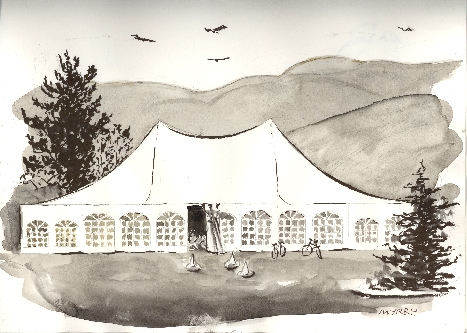
Sketch by Trudy “Myrrh” Reagan
Weighing Marriage Equality
I do not believe that those who oppose same sex marriage are necessarily homophobic. I do believe marriage equality is a civil rights issue and that fair-minded people will eventually agree that denial of marriage rights is a form of discrimination. As individual states end discrimination against same sex couples, people will realize that the institution is actually being strengthened.
Those who stand in opposition have argued that we can’t redefine marriage. Marriage they say is an institution almost as old as civilization itself and has always been between a man and a woman. If we start redefining marriage, they charge, who knows where we will end up? This is what we know as the “slippery slope” argument. Here’s how it goes: If we legalize gay marriage, what is to stop us from legalizing polygamy? What about legalizing marriage between adults and children or humans and animals?
In reality, the premise that marriage has never changed or been redefined is false. Marriage has been redefined through history and has changed with the times, and not just by expanding it to include interracial couples. It has changed as the roles of men and women in society have changed. As we have changed from an agrarian to a more industrialized society the role of the family has changed, as well. On the farm, the husband went out every day to work the fields while the wife stayed in the farmhouse and cared for the children. Now, both men and women work outside the home. Many couples choose to not have children. Marriage has changed.
Women were once considered intellectually and physically inferior to men. They were denied equal access to education. They were denied the right to own property or even vote. These barriers to sexual equality have fallen with the rise of the modern feminist movement.
I know this is shocking and offensive to say today, but there was a saying among males I knew as a teenager in the sixties. That saying was “a man can’t rape his wife.” It meant that a woman couldn’t deny her husband sex however and whenever he wanted. It was not said in polite society, but it was said in the locker rooms and bars where men would speak freely between themselves of how they saw a woman’s function in marriage. That I have not heard that thought expressed in decades indicates how much our attitudes have changed.
It was not long ago that women were considered a part of a man’s property in marriage. Some would argue that a wife was no different than a prostitute for her husband. He had paid for her keep and so had earned the right to do as he pleased with her. He brought home the bacon, and she kept him happy with a clean house, dinner on the table, a brood of happy children, and, of course, sex. This relationship was validated with Bible verses in the same way that keeping African-Americans as slaves was justified. A wife was expected to submit to her husband. The husband was the master of the house whom his wife and children were expected to obey. The Bible has been used to justify modern polygamy, but only for the purpose of allowing the male to possess multiple females.
What has changed is the relationship of power in the marriage relationship, or at least civil marriage. Woman is now equal to the man with equal rights within marriage. Husbands can no longer force their wives to have sex with them because rape is rape, period.
The jobs of housework and child raising are still not as equally divided as they should be, but that continues to change. It is not uncommon now for men to chose to stay home to raise children. Even if men are not doing an equal share of housework, they are doing more than their fathers and grandfathers did.
When I hear the word equality I think of a balanced scale. On this scale, there are two objects. They may be the similar or they may be different. Yet each has the same weight. Each is at the same level. Neither one is higher or lower in relation to the other.
If we define marriage as a relationship between two equal partners, we can refute the “slippery slope” argument. We recognize that sexual relations between adults and children are unhealthy because the relationship in power is unequal. The adult always has power over the child. Therefore marriage between adults and children is not healthy for society. The relationship between humans and animals is unequal, as well.
Polygamy should be rejected for the same reason. Where one man has multiple wives an unequal relationship of power exists. That unbalance would exist if a woman were allowed to take multiple husbands. While some advocate polyamory to advance gender equality, this arrangement does not have basic human nature in its favor. It is difficult, if not impossible, to maintain relationships of multiple partners without jealousy and favoritism coming into play.
That is the appeal I make to reasonable people. They understand what science continues to affirm. Sexual orientation is not a choice, but is biologically determined. When I was a closeted gay teenager, homosexuality was considered a psychological defect. Today, the scientific community recognizes that lesbians and gay men can have healthy, loving relationships. They are capable of raising healthy and happy children.
I do not expect these arguments to sway religious conservatives who are hostile to scientific evidence and obsessed in their opposition to gay rights. I wonder if this realignment of relations between men and women in marriage is at the root of their obsession with preventing lesbians and gays from marrying. They would have us go back to the days when the woman submitted herself to her husband and when ministers said, ” I now pronounce you man and wife.” Under that definition of marriage, the ceremony allows a man to stay a man, but the woman must change to become a wife.
Years after marriage rights have been granted to every loving couple in every state of the nation, we will look back and wonder what all the fuss was about. Perhaps we will recognize that these marriages were the result of a society that walked the path toward greater equality and social justice for all.
World’s Greatest Tweeter?
My recent Twitter post wishing a happy birthday to Ray Bradbury got me at least one follower, and she doesn’t even have naked pictures she wants to show me. It’s always nice to know someone is reading. I am reminded of my own encounter with Bradbury that I am now a bit embarrassed about. I got a chance to speak to the author when I was a nineteen-year-old student at Palomar College in Southern California. Bradbury, who has boasted of being the world’s greatest writer, was giving a lecture in the college’s geodesic dome auditorium. During the question and answer period, I told him I wanted to be the world’s greatest writer, too, and asked for advice. Bradbury laughed and told everyone, “See, there is room for more than one of us.” He then advised me to work hard, keep practicing, and expect rejection. He told me he still received rejection letters from magazines every week. Most people are lazy and give up easily, he said. Good writers do not give up and keep submitting their work until they get published.
Later, I realized his comment about sharing the claim to greatness was really saying that I should find my own niche. I gave up on writing mediocre science fiction stories and spent a couple decades trying to find that niche. I wrote essays about my environmental and political interests. I wrote humor and satire because I have loved reading great humorists and satirists like Mark Twain and Art Buchwald. I had a fair amount of success getting letters to the editor published, especially when I was involved in a small political group that advocated growth control. That was when I was living in the small town of San Marcos, where Palomar College is located.
After moving to Berkeley, I worked for a non-profit agency that assisted homeless people seeking employment. That was where I became a resume writer and learned how to write functional resumes for our clients. Functional resumes are different from chronological in that they emphasize skills over employment history. The homeless population we worked with had large gaps in their work histories. Many were making career changes, either out of choice or necessity. For them, the functional resume, as taught to us by the late Yana Parker, was the best choice for marketing themselves to employers. An example is my resume on my web site. As I worked with job seekers, I found myself really enjoying writing resumes. Needless to say, my coworkers found my attitude quite odd since they hated that part of their jobs. For me, it was an exciting opportunity to hear people’s stories, and I heard a lot of great ones. Many were not suitable for a resume, but others were after a little creativity was employed. When people saw their stories on paper, they were always thankful. Then there was the feedback that could be quantified. I knew the resumes I created were effective when people reported back that they were getting interviews. So I could say that, for a time, I did find that niche. I was the world’s greatest resume writer.
A number of people have told me I am a good writer but I have never had the confidence to attempt to make money from it. Given the current media landscape, it is getting more difficult to make writing a career, and anyone can get themselves published without worrying about editors or rejection letters. We can Twitter and Facebook. We can blog and post to listservs. We do this without an editor to tell us if what we are writing is worth publishing. We are left to become our own editors, which means we must look at our own work critically. Yet how many of us can be objective about our creations?
The fallout of the freedom to publish without restriction includes spam emails and tweets. We flame each other in newsgroups and post inappropriate comments to news stories. The web is full of so many words and so little worth reading. Yet amid all the noise, I find voices worth hearing. I will compose, revise, and revise again, hoping that the result means something to someone, somewhere.
The Eagle lands on Pomerado Road
I am probably one of the few people who doesn’t have a memory of Apollo 11 that involves television. I did not see Walter Cronkite pause at the announcement that the Eagle had landed. I had to work that night, otherwise I would have probably been glued to the tube with the rest of the world. That summer, I had just graduated from High School and was still Tom Campbell. I was living with Tad and Alice Yamaguchi in Poway, Ca. They would adopt me in the fall.
My first full time job was washing dishes at a restaurant that had just opened by the I-15 freeway in Rancho Bernardo, 5 miles away. I was nineteen, but I still did not know how to drive, so I bought an old 1-speed bicycle and rode to work. My route was north on Pomerado Road, then west on Rancho Bernardo Road. Frequently, my ride was in the middle of the night, as it was on the night of the moon landing. I brought a small transistor radio to work and tried to listen best I could. Then, when I got off work, I tied the radio to the handlebars of the bike and rode home listening to the coverage.
In those days, there was not much of anything between Poway and Rancho Bernardo along Pormerado Road. There were no houses or stores. I do remember one church somewhere between the two towns. There were no streetlights along the narrow two-lane road, and my small headlight barely kept me from riding off into the ditch. I do remember being able to see the moon that night, and a quick check of the Internet confirmed that the moon was in its first quarter on 7/20/09. Today, it seems so much like a dream as I think about riding that old bike down the road in the dark. It was so empty, I felt like I was on the moon myself. My only connections to civilization were the blacktop below me and the radio receiving the voices from that visible piece of disk high above me. When I got home, I went straight to bed. I did not need to see anymore that night. I had all the information I needed. I knew that when I looked at the moon again, it would not be the same.
-
Archives
- May 2026 (2)
- March 2026 (1)
- July 2024 (1)
- May 2023 (1)
- May 2022 (1)
- September 2021 (1)
- March 2021 (1)
- October 2020 (2)
- September 2020 (1)
- May 2020 (1)
- April 2020 (1)
- March 2020 (2)
-
Categories
-
RSS
Entries RSS
Comments RSS

