My emails to my senators on the Supreme Court vacancy
To Senator Feinstein:
Thank you for your statement “Under no circumstances should the Senate consider a replacement for Justice Ginsburg until after the presidential inauguration.”
I am not surprised by Majority Leader McConnell’s statement that he would fill the vacancy on the Supreme Court that was created by the death of Justice Ginsberg. Nor am I surprised that he made his statement as soon as we received the news of the terrible loss to this country, not even giving us sufficient time to mourn and reflect on her accomplishments throughout her long career. I am not surprised that he would take this course in direct contradiction of his position in 2016 when he refused to even provide Merrick Garland a hearing for a vacancy created by the death of Justice Scalia that February. I am not surprised because he said he would do it in 2019. In fact, his response to the question was quite blunt. “I would fill it,” he told the audience, which responded with laughter.
I am not surprised, yet I am no less disgusted by both Mr. McConnell’s action and the audience reaction, as if this is all just a power game. Well, this is not a game. We elect our senators to act fairly and ethically while they are in office. I believe we should hold our elected officials to a higher standard.
One difference between now and 2016 was that the court vacancy then was created in February, just as the primary process was starting. We are now at six weeks before the general election with Congress getting ready to shut down to conduct their re election campaigns. That should be reason enough to wait until a new President and new Senate are elected and sworn into office.
Sadly. Mr. McConnell does not feel the same urgency to provide our country with pandemic relief. He has not bothered to call a vote on the HEROES Act, months after it was passed by the House of Representatives.
I agree that confirmation of a new Supreme Court justice can and should wait until 2021. Thank you for taking your position.
My message to Senator Harris is a request to join Senator Feinstein on her position.
A Tribute to Friend Stephen Matchett
A well known and loved Quaker in the San Francisco Bay Area, Stephen Matchett, died on Tuesday, May 19, 2020. Stephen was a member of San Francisco Monthly Meeting of the Religious Society of Friends. I was not a close friend of Stephen’s but I did spend a fair amount of time with him, especially while riding bicycles.
Stephen died on the anniversary of the death of my friend, housemate, and bicycle activist Bob Berry. May 19 is the birthdate of political activist Malcolm X, who would have been 95 on the day Stephen died.
Stephen was a political activist. He was probably best known as a facilitator and organizer with Alternatives to Violence Project (AVP). AVP was developed by Quakers to teach conflict resolution skills for people in prison. In recent years, AVP has expanded beyond prisons and conducts workshops for those who want to end violence in their communities. Stephen would travel to prisons throughout California on his bicycle, carrying all the workshop materials he needed on his bike. Stephen was very organized in his ability to pack and transport large loads.
Stephen not only traveled everywhere by bike and public transit, he made a decision to never ride in a private vehicle for the rest of his life. This included regular Quaker gatherings in California, such as College Park Quarterly Meeting and Pacific Yearly Meeting.
During one Pacific Yearly Meeting session held at Walker Creek Ranch in Marin County, those of us who pedaled to the meeting gathered for a group photo before the ride home. I use that photo for my Twitter profile page. Stephen is the tallest in the group and next to me on my right.

When I was editor of the Strawberry Creek Monthly Meeting newsletter, I would fill blank spaces with quotations from Quakers and other activists in the peace, environmental, and social justice movements. One of my quotes came from Stephen Matchett. It was at a yearly meeting at Walker Creek Ranch that Stephen spoke at a meeting for worship before plenary. “Tell me more about this God you don’t believe in. Chances are I don’t believe in that God either.” When I asked for his permission to use the quote, Stephen said he wasn’t sure if his statement was original. Well, it is original enough for me. I used it several times.
Stephen did believe in God. He facilitated Bible study sessions during yearly and quarterly meetings. I found it interesting that an openly gay man would have no problem in leading discussions on the Bible. Stephen has helped me deal with my own issues with Christianity and become more comfortable with a book I used to consider a source of oppression.
I would talk to Stephen during travel to and from the spring session of College Park Quarterly Meeting. The spring meeting is usually held during the third weekend in May at Ben Lomond Quaker Center in the Santa Cruz mountains. We would both travel by use of train, bus, and bike. While I took Amtrak’s Capitol Corridor from Berkeley to San Jose, Stephen used CalTrain from San Francisco. During one of our last conversations, Stephen was debating not renewing his driver’s license and just caring a non driver’s ID card.
Spring quarterly meeting was held this past weekend, May 15-17. Unfortunately, due to the pandemic, it was conducted via Zoom, instead of at Ben Lomond.
Early this spring, Stephen was diagnosed with a brain tumor and spent his final days at the Coming Home Hospice in San Francisco.
On the day of Stephen’s passing, his brother David posted the following to Stephen’s Caring Bridge site.
Stephen is no more Stephen —
I went over about 3 after the chaplain said “it’s now.” It’s meaning the world to me that I got to be there.
He was breathing when I went in, I called my parents to say I was there, I read him something my father had written him, then something from my cousin, and played him a message someone had recorded for him today, and then when I was returning the chaplain’s call we talked about how you could tell, and I said, well, it looks like his chest isn’t moving. So somewhere in there he stopped breathing, and I couldn’t say when. But there was no sigh, no gasp, no struggle — I can’t imagine a more peaceful way to leave.
This won’t be the last post here, but it’s the last post from a day when Stephen was with us. Entering a new reality (all of us).
In 2013, Stephen led a Quaker Center weekend workshop titled “Come As You Are: Reading the Bible with Friends.” The announcement includes the following biography.
Stephen Matchett is a Quaker by birth and by convincement, and a 30-year member of San Francisco Monthly Meeting. Once an appellate criminal defense lawyer, he now spends much of his time facilitating conflict resolution workshops in prisons and in the community with the Alternatives to Violence Project (AVP). In recent years he has had an active traveling ministry among unprogrammed Friends, offering presentations on reading early Quaker writers and on Friends’ beliefs, and following a call to support and encourage contemporary Quakers’ (re)acquaintance and engagement with the Bible. In recent years he has been convening early morning Bible study at College Park Quarterly and Pacific Yearly Meetings, and the growing number of Friends finding meaning in those sessions led him to offer this program last year and to agree to offer it again this year upon request.
Staying Home, Part 2
I am beginning my second week of obeying my state’s stay-at-home orders. I have decided to remain in my house until at least the end of the month. As I wrote in my previous blog post, I consider this my job now. I need to send the message that I take this pandemic seriously and am willing to do whatever it takes to stop the spread of SARS-CoV-2.
Over the next week, I will be watching the news closely. If I feel comfortable, I may decide to return to work on April 1. In the meantime, I have been assured that my insurance benefits through Alameda Alliance are not in jeopardy if I fail to work the required 80 hours per month. I do want to get back to serving my recipients. I expect that I would be going directly to work and then directly home, avoiding any other social contact. Then I will consider if it is OK to return to regular shopping. Yes, we are running low on toilet paper, and my prescription for my cholesterol-lowering drug needs to be refilled by April 5.
Like many I am spending more time online. My weekly Quaker meetings for worship (Strawberry Creek Meeting and Berkeley Meeting) are now conducted via Zoom. I have another Zoom meeting coming up this week to decide if we are going to cancel our spring quarterly meeting that is scheduled for mid-May.
My biggest disappointment is that we won’t be holding our annual Berkeley CROP Hunger Walk next Sunday, as planned. It is organized by the international relief organization, Church Word Service, and allows us to fundraise for local hunger relief agencies. Our Berkeley agencies are the Berkeley Food Pantry (run by Berkeley Friends Church), Dorothy Day House, and Youth Spirit Artworks. The money is split with CWS getting 75% and the local agencies receiving 25%. Even though the walk is cancelled you can still donate online to our Berkeley Quakers Team, https://www.crophungerwalk.org/berkeleyca/BerkeleyQuakers . Thanks.
Why I’m Staying Home
Why I’m Staying Home
3/17/2020
While I have been considering how I would need to respond the COVID-19 epidemic for a number of weeks now, it all became very real for me when I watched Governor Gavin Newsom’s press conference on Sunday, March 15. Right off the bat, he announced that everyone 65 years and older need to stay in their homes and not go anywhere; no work, no shopping, nothing.
Yes, he was talking to me. I am a couple of weeks away from my 70th birthday. The day before, I was standing with the crowd at Berkeley Bowl West, buying milk and thinking that this may not have been a good idea. However, I needed milk, just like I needed to do my work as an in home care provider earlier that day. I just got on my bicycle and rode to the places I needed to go.
I didn’t need another job. However, Governor Newsom has given me a new job. I now have the job of staying home. That changes the other jobs I have.
Even though I don’t smoke or have any other health problems that put me at risk for serious complications from COVID-19, I do care for people who have those risks, such as diabetes. I have not been experiencing any of the symptoms, and the chances I have come in contact with a person with the virus are low. If people without symptoms are able to spread the virus to others, however, that justifies me staying away from others who are at risk.
My IHSS work mostly involves housekeeping and shopping. While another person could fill in for me and do my jobs, finding a person to work in my place will not be easy. I am hoping for guidance from my union, SEIU 2015. Governor Newsom said at his press conference that he was talking with the union.
If I get COVID-19 and do recover, there is still the chance that I would become seriously ill, possibly needing a hospital bed and a respirator, I would become a part of the overload that our hospitals are facing right now. By keeping myself away from the virus, I would be part of the solution and not be an additional burden on our healthcare system.
So this is my new job. I am letting the world know I am taking this crisis seriously by complying with the Governor’s directive. That directive came one day before the counties in the entire Bay Area decided that everyone, regardless of age, need to limit their activities and stay home as much as possible. I am working at home, doing the jobs I don’t get paid for. I have been spending more time on Zoom, including two Quaker meetings for worship on Sunday, a Quaker clerks’ meeting before that, and a meeting of the Alameda County chapter of Citizens’ Climate Lobby last night. I am not hurting financially. I do have 8 hours in sick pay through my union contract. I will be getting my social security check by direct deposit next week. On my birthday, I will get a nice, new present from New York Life, as I start drawing down on my 403b retirement account. in addition to Social Security, I am on Medicare. My main concern is that I have a health plan through my work, Alameda Alliance, that is my supplemental insurance for what Medicare does not pay for, such as dental care and prescription drugs. For that benefit I need to work 80 hours per month. I know I will fall short this month. I am hoping for some guidance from my union.
I am optimistic that I will be celebrating my 70th birthday, even if it is at home. After that my goal is to be alive on Tuesday, November 3, when I cast my ballot in the presidential election. I will vote to remove the incompetent and corrupt Donald Trump from office. Join me in voting for the Democratic Party nominee for President and replacing the cowardly Republican senators who failed to do their duties to remove Trump from office by impeachment.
Un Happy New Year
New Year 2020 is not going well for many of us. Wild fires in Australia are being fueled by a warming climate. Donald Trump kills an Iranian general and risks war with that country. Angry, depressed, and frustrated, I decided to go on a bike ride. After completing needed business this morning, I decided to take a ride across the Richmond-San Rafael bridge. I have wanted to return since riding out with many cyclists on the day it opened. I wanted to see if the trail was getting sufficient use. I also thought of taking a ride on SMART, which has been extended to the Larkspur ferry. The weather was just right for a ride across the bridge. Unfortunately, I never made it.
Leaving Point Richmond, I arrived at the intersection where the trail crosses the I-580 off ramp and then goes under the freeway to continue on the side that faces Chevron. A truck was parked right at the corner, completely blocking the entrance to the path on the other side of the street. A man was standing on the truck, trying to adjust the Walk sign. I saw that another path could get me around the blocked path, so I rode across the street, noticing that a car was approaching, and I didn’t know which of us had the green light. I quickly rode onto the adjacent path and suddenly found myself being thrown from my bike. I landed on the pavement on my left hand and left knee. The worker came rushing to help, pulling my bicycle off of me. I noticed that the knuckles on both of my hands were scraped and bleeding a bit. I put a small hole in the knee of my new jeans. I helped myself up to the curb as the worker explained that someone had hit the walk sign, and he was trying to fix it. I looked back and saw the cause of my tumble. There was a hole in the middle of the path that had a small piece of metal sticking up from it. I did not see it as I was crossing the street and ran right into it. Damage to the bike was minimal. My front reflector broke off my handlebars. The chain came off my front sprocket, although I did not notice until after I coasted down to the underpass, where I found a bench to sit on for awhile.
I was hoping that my injuries were minor. Then I noticed my little finger getting sore and stiff. After getting the chain back onto the sprocket, I realized I needed to get home and get an ice pack on my injured hand. I walked my bike back to Point Richmond. On the way, I noticed that a short pole was covering the hole that caused my tumble. It appears that the worker had removed the pole so he could drive his truck onto the path by the signal light. The truck was now gone, and the worker had returned the pole to its place. If it had been there before, I definitely would have seen it and not run into it.
At Point Richmond, I waited for the 72M that would get me back to Berkeley via San Pablo Avenue. It was then a one block walk to my house on Channing Way.
I spent the rest of the afternoon on my bed with a cold pack on my hand. I noticed that it was slightly swollen. I discovered a large bruise under my knee where I had ripped a hole in my jeans.
Although I never made it to the bridge to assess the traffic situation, I saw that the trail leading to the bridge was getting some decent ridership.
I am still hopeful I will live to celebrate my 70th birthday this year, if I can keep myself all in one piece.
My email – Congress needs to impeach Trump
While I would have liked to have seen more than two articles of impeachment being voted on by Congress, I believe that these two articles are sufficient to remove Donald Trump from the office he continues to abuse. Speaker Pelosi has moved with appropriate caution on the use of the power of impeachment. She was criticized when she refused to impeach George Bush over the war in Iraq. I agreed with her then, I agree with her now. Impeachment is a serious use of congressional power and should not be used casually.
On the other hand, I am extremely angry with congressional Republicans who appear to value the interests of their political party over the wellbeing of our country. This is not the Republican Party of 1974, when its leaders convinced Richard Nixon to resign rather than be impeached. It shows that the Republican Party no longer exists. It is now the party of Trump.
When Robert Mueller’s report was released, Republicans defended Donald Trump’s actions by arguing that he was a political novice who didn’t know what he was doing was illegal, i.e. inviting a foreign government to interfere with an election and obstructing the investigation of that interference. Then, the very next day after Robert Mueller testified before Congress, Donald Trump, in a phone call with the President of Ukraine, asked a foreign government to interfere with the 2020 election. So if Mr. Trump was ignorant of the law then, he cannot argue that now. In fact, one argument on why he continues to abuse the powers of his office is that Congress has failed to act on his past offenses. If that is the case, he is sure to continue to commit these abuses through the rest of his term.
As many have pointed out, this is more than a case of bribery and coverup. To argue that we should wait until the next election to remove Donald Trump from office fails to address the real concern, that Russia interfered with the 2016 presidential election and are clearly doing so again in the 2020 election. Our democracy is under attack, while Donald Trump and congressional Republicans continue to be a willing partners in that attack. Even in the impeachment hearings, they are spreading the Russian propaganda that Ukraine interfered in 2016 on behalf of Hillary Clinton, as well as other baseless charges against the Bidens.
In addition, if Congress does not use its power to impeach when appropriate, then impeachment as a power that has been lost. Future presidents will agree with Donald Trump that Article II gives them the power to do anything they want.
The Republicans may be right that Democratic members of Congress risk losing reelection by supporting impeachment. Like Speaker Pelosi, I am willing to take that risk. That is the risk of putting your country before your political party. I am ready to work for the reelection of those who vote to defend the Constitution against the blatant misuse of presidential power.
Poway, Spring 1969
The news of the horrible shooting at Chabad of Poway has affected me in a personal way. It brings the memories of my own experience living in Poway, California. It was about 50 years ago that I moved to Poway and would live there, off and on for a couple of years. The news coverage reveals a Poway in 2019 that seems different than the one where I lived in 1969. The shooting itself reveals a Poway where little has changed.
Much of this story is in a personal web page I created on Tripod, which I call my adoption story. http://tfyamaguchi.tripod.com/adoption.html It was Easter Sunday in 1969 when my brother Joe invited me to attend mass at the San Diego Mission. He was a regular attender of La Jolla Monthly Meeting of the Religious Society of Friends (Quakers). I had pleaded with him a number of times to take me to Quaker Meeting, and he had refused my requests. Now, sitting in the crowded, historic, Catholic mission, my brother turned to me and whispered, “This is boring. Do you want to leave?” My answer was yes, and we ended up at La Jolla meeting for worship. It was my first Quaker meeting, and I felt like I had arrived home.
It was there that I met Tad and Alice Yamaguchi. When they found out I was living in rather miserable conditions in a boarding house in the North Park section of San Diego, they offered me a room in their home in Poway. I enthusiastically joined the Yamaguchi communal household. By that fall, my own last name would change from Campbell to Yamaguchi.
Poway in 1969 was a small and growing suburb. There were large open spaces that have since been filled in with more housing. It was just about 100% WASP. Many of the residents were in the Navy, being an easy commute from Miramar Naval Air Station. Poway public schools had a reputation of being progressive, but I would not know. I was determined to finish my high school year at Mission Bay and got a ride there every day from a teacher who also lived in Poway. The most ethnic diversity in the area was to the north in Escondido, which has a large Latino population. That is where a mosque was burned a few weeks ago, and the suspected synagogue shooter is considered a suspect in that arson fire. The only Jewish person I remember meeting while living in Poway was a coworker in a restaurant in Rancho Bernardo, which is located between Poway and Escondido.
When I moved in Alice told me about the racism she experienced in Poway. A black family was visiting their home on the quiet cul-de-sac. She went for a walk down the street with the two children of the family. As they walked hand-in-hand, she heard the neighbors talking loudly to each other. They were clearly intent on having their voices heard by Alice and the children, letting them know they were not welcome in the neighborhood. Hearing the children she was with being called “niggers” was too much for Alice to bear. She rushed the children back to the house with tears streaming down her face. When I moved in, there was a sign on the door with the message that all people were welcome, regardless of race and religion. At least there was one place on that cul-de-sac where that was the case.
Another time when our politics conflicted with the conservative views of our neighbors was on a day of nationwide protests against the Vietnam War. A small group of us stood on Poway Road with signs stating our opposition to the war. Those who drove by us responded with insults, calling us communists and traitors. I was actually afraid for my life that day. Fortunately, there was no violence.
There were other events that captured my attention in 1969. One was the first humans to walk on the moon, which I described in my blog post The Eagle Lands on Pomerado Road. https://tomyamaguchi.blog/2009/07/20/the-eagle-lands-on-pomerado-road/ Woodstock happened that summer, as well as the Manson Family murders. One news event that failed to reach me in that quiet town of Poway was the Stonewall riots. I had heard the news Judy Garland’s death on the radio while riding in a car pool headed to San Marcos Community College. As we cruised along the 78 freeway, George Jessel was offering his condolences and sharing his memories of the singer. Years later, I learned how Garland’s death had a role in the rise of the modern gay rights movement. I was in the closet then. Poway in 1969 was not a place where someone would want to come out as gay.
Decades after living in northern San Diego County, I am fascinated by how much has changed there, especially in politics. After an extremely close reelection, conservative Republican Darrell Issa decided to retire from his congressional seat in 2016 and was replaced by a Democrat. Orange County, directly to the north of San Diego and known for being the bedrock of Republicanism, switched to entirely Democratic House representatives in that election.
When I lived there, both state and national representatives were proud members of the John Birch Society. Given the proximity of Camp Pendleton and the already mentioned Naval Air Station, it would not be surprising to find such a conservative bent in the electorate. Now, that electorate is changing with the coast becoming more urban and more liberal. Unfortunately, racism, antisemitism, and anti-immigration sentiment is still alive in North County, as that part of San Diego is known. The nineteen-year-old white man suspected in two hate crimes has made that evident. We will know more about his beliefs and his world view as the story unfolds. The sad news is there are too many more people just like him.
Five important things I want you to consider as we approach the November election
Important Thing 1
Yes, voting is important. We all need to vote on November 6. This year, voting is not enough. We need to really engage and be active in this election. Find a candidate. Find a campaign. It could be a ballot proposition. Volunteer your time. Give some money. Do as much as you can to increase the turnout in this election.
After the 2016 election, a friend of mine confessed, “I wish I had done more than vote.” I had just finished putting in a number of hours in the Hillary Clinton campaign. Yes, we lost. Do I regret the time I spent making calls to Nevada and other states? Not one moment! In fact, we carried Nevada and held on to the Senate seat being vacated by Harry Reid. I like to think that I still made a difference.
Get involved in the election. Then you won’t be waking up on November 7 saying, “I wish I had done more than vote.”
Important Thing 2
Don’t be discouraged and give up. This is especially important if you are not yet convinced that voting is important. There are people who will try to convince you that your vote is useless and that the candidates are all the same, corrupt and untrustworthy. They will use propaganda and misinformation to drive their message, just as they did in 2016. They will convince your family and friends to share and promote their message on social media, just as they did in 2016.
There is an old Twilight Zone episode, The Monsters Are Due on Maple Street. It is about an invasion of the Earth where the invaders from space hide themselves from the small neighborhood they are invading. The invaders create suspicion among the neighbors to convince them that each other is the enemy. The Earthlings end up violently attacking and destroying each other. At the end of the episode, the outer space invaders reveal themselves to the audience, pleased with their victory as they head off to invade another neighborhood using the same tactics. A common theme in Rod Serling’s Twilight Zone stories, this one included, was McCarthyism, which threatened American democracy in the 1950s. That anti-McCarthyism message applies today in the age of Trump. Think of Putin and the Russian oligarchs as the invading force whose goal is getting us to fight and destroy each other. If they can destroy our country from within, they can diminish our standing in the world and replace us as a world power. Their eventual goal is to replace democracies with authoritarian regimes. Their tactics worked in 2016, and they are using them again in 2018.
Don’t give up. Get engaged in this election and stay engaged.
Important Thing 3
Stay focused on this election. There will be plenty of time to think about the 2020 presidential election starting in 2019. Governors, senators, house members, and state representatives are not as sexy as a presidential campaign, and the media would rather have our attention diverted to their stories on the latest celebrity who is considering throwing her or his hat into the ring. Don’t let that happen. That is how people end up not voting in so called off year elections. That includes this year, 2018. Remember Important Thing 1. As my friend, the late storyteller Orunamamu, once said, “PAY ATTENTION!”
We can’t regain the White House until 2020. We don’t have to wait until then to take back our government. By taking back the House and Senate, we can stop the Trump agenda. If we had the Senate this year, our next Supreme Court justice would not be handpicked by the Federalist Society and the Religious Right.
State elections are important, too. State governments draw district boundaries. If we want to end gerrymandering, we need to become engaged in the election of governors and state representatives.
Important Thing 4
We need to support and vote for Democrats. That is the only way to get the Trump enablers out of power. It is clear now that the Republican Party no longer exists. It has been replaced by the Party of Trump, which has nothing in common with traditional Republican values. A Republican Party would not start a trade war by placing tariffs on imports produced by our allies.
Our Two Party System is flawed, and we should work to fix those flaws. Until then, this is the system we have, and we need to work within that system. If you feel that voting for a Democrat requires you to hold your nose, then hold your nose and vote for Democrats. If you voted for Jill Stein or Gary Johnson or if you decided to not vote all in 2016, do you still believe there is no difference between Hillary Clinton and Donald Trump? Are you willing to risk having Congress controlled by the Party of Trump in 2019 because the Democratic candidates did not meet your high standards of progressive perfection?
Yes, Putin and the Russian oligarchs are interfering in the 2018 election. Their goal is to dissuade us from voting for Democrats. They are especially targeting minority voters with hashtags like #JustWalkAway. Don’t let them fool you. Support and vote for Democrats.
Important Thing 5
Prepare to be disappointed. Yes, the candidates, like all human beings, are flawed. Once in office, they will disappoint us. That is why we need to continue to be engaged after the election and hold them accountable. When LGBTQ activists realized that Obama was dragging his feet on repeal of Don’t Ask Don’t Tell, they spoke up. They chained themselves to the gates of the White House. They interrupted the luncheons he hosted to celebrate LGBTQ Pride. They were criticized for being so “uncivil.” Sound familiar?
Get engaged. Stay engaged. Don’t get discouraged. Don’t give up. Got it? Thanks for listening.
Does Donald Trump have a learning disability?
Does Donald Trump have a learning disability? I have been considering this as a blog post ever since Trump entered the White House. I am not the first to ask this question. Even his own staff have questioned Trump’s reading ability as described in this article in the Independent.
I have been reluctant to write this post due to the stigma around learning disabilities. I know that stigma, having two daughters with diagnosed learning disabilities. I have wondered if I have an undiagnosed learning disability myself. Although I have come to enjoy reading, I struggled with reading and writing in school. After being held back in second grade, a summer school course in phonics helped a lot. I am still a slow reader, but I have gotten better. I am best with newspapers, magazines, and books with simple vocabulary, generally at an 8th grade level. Computers have helped me to write and organize my thoughts. I know that dyslexia and learning disabilities are different from intelligence. People still confuse the two. Trump has even responded to such concerns as an attack on his intelligence, tweeting he is “like, really smart.”
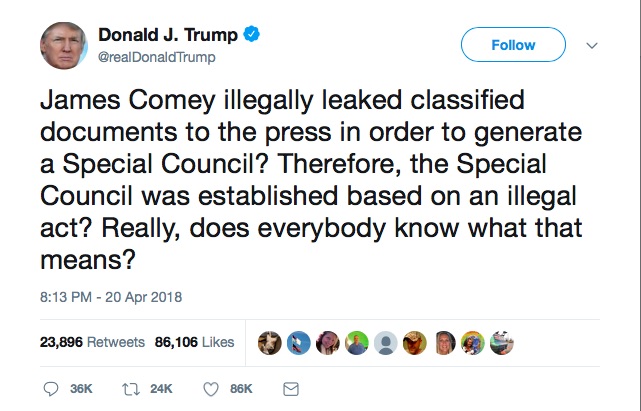
In addition to learning about his lack of interest in books, we learn more about Trump’s writing in his tweets. There are he misspellings and strange grammar. Most recently, he tweeted this: “James Comey illegally leaked classified documents to the press in order of generate a Special Council?” He uses the same spelling for counsel in the second half of the tweet.
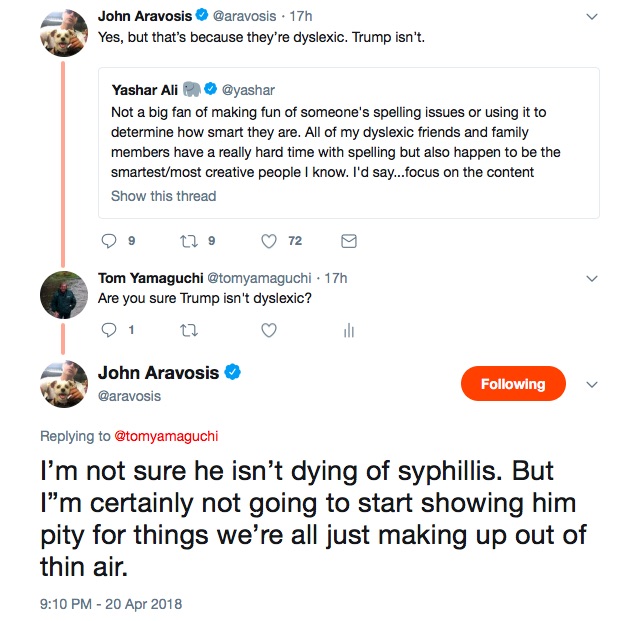
That led Yashar Ali of New York Magazine to tweet “Not a big fan of making fun of someone’s spelling issues or using it to determine how smart they are. All of my dyslexic friends and family members have a really hard time with spelling but also happen to be the smartest/most creative people I know. I’d say…focus on the content”. In response, John Aravosis of AMERICAblog wrote, “Yes, but that’s because they’re dyslexic. Trump isn’t.” And in response to my questioning, Aravosis wrote, “I’m not sure he isn’t dying of syphillis. But I”m certainly not going to start showing him pity for things we’re all just making up out of thin air.”
I admit I do not know, anymore than anyone else, if Trump is learning disabled, and I am not using that as an excuse to pity him. I will only refer to a bumpersticker I once saw in my Berkeley neighborhood. (BTW Berkeley, CA is considered the birthplace of the disability rights movement, going back to when Ed Roberts studied at the University of California.) The bumpersticker read, “Attitudes are the real disabilities.” If that is the case, then Trump’s real disability is not his struggle with reading, but his refusal to deal with it.
The State of New York has had two governors that were unable to read. The most recent was David Paterson, who is unable to read due to physical disability. Before him Nelson Rockefeller was not only a governor, but a vice president and presidential candidate. Rockefeller was dyslexic. About his struggle with reading, Rockefeller gave this advice:
Accept the fact that you have a problem—don’t just try to hide it.
Refuse to feel sorry for yourself.
Realize that you don’t have an excuse—you have a challenge.
Face the challenge.
Work harder and learn mental discipline—the capacity for total concentration—and
Never Quit.
http://www.memphisdyslexia.org/articles/rockefeller.html
Trump has a lot of issues that I have previously posted to this blog. They are all reasons why Trump is completely unfit to hold the office of president. If he does have a disability and is unwilling to accept it, this is an indication of a bigger issue with Trump and his self image. Remember that Trump the candidate ridiculed a reporter with a physical disability. I am sure that Trump considers disability a weakness, and he does not want to appear weak. It is entirely consistent with how he projects himself to the world. He builds himself up by knocking others down. He can’t take a joke at his own expense and is unable to laugh at himself. He never apologizes or admits he is wrong. He seems obsessed with his masculinity. Trump considers any attack that reveals him to be weak to be an attack his masculinity.
Trump may be intelligent, but he has shown himself to be mentally lazy. Not only does Trump not read, he doesn’t listen either. Worse still, he doesn’t care. He doesn’t know, and he has no interest in learning.
I don’t want to sound ageist, but it is true that, as we get older, we become less likely to change. Trump is 71. If he is disabled and his real disability is his attitude, I doubt that is going to change.
-
Archives
- May 2026 (2)
- March 2026 (1)
- July 2024 (1)
- May 2023 (1)
- May 2022 (1)
- September 2021 (1)
- March 2021 (1)
- October 2020 (2)
- September 2020 (1)
- May 2020 (1)
- April 2020 (1)
- March 2020 (2)
-
Categories
-
RSS
Entries RSS
Comments RSS
 Tomyamaguchi's Weblog