How an atheist views the afterlife
I was really moved by Terry Gross’ interview with historian Tony Judt on her Fresh Air program on March 29. Judt, who is now living with Lou Gehrig’s Disease, discussed how his disability has affected his work and thinking. I was especially impressed with his comments about death and want to share them here. As I turn 60 years old, I have been giving a lot of thought to the end of life. This is very useful advice for believers and nonbelievers alike.
“I don’t believe in an afterlife. I don’t believe in a single or multiple godhead. I respect people who do, but I don’t believe it myself. But there’s a big ‘but’ which enters in here. I am much more conscious than I ever was — for obvious reasons — on what it will mean to people left behind once I’m dead. It won’t mean anything for me. But it will mean a lot to them. It’s important to them — by which I mean my children or my wife or my very close friends — that some spirit of me is in a positive way present in their lives, in their heads, in their imaginations and so on. So [in] one curious way I’ve come to believe in the afterlife — as a place where I still have moral responsibilities, just as I do in this life — except that I can only exercise them before I get there. Once I get there, it will be too late. So, no God. No organized religion. But a developing sense that there’s something bigger than the world we live in, including after we die, and we have responsibilities in that world.”
More available at
http://www.npr.org/templates/story/story.php?storyId=125231223
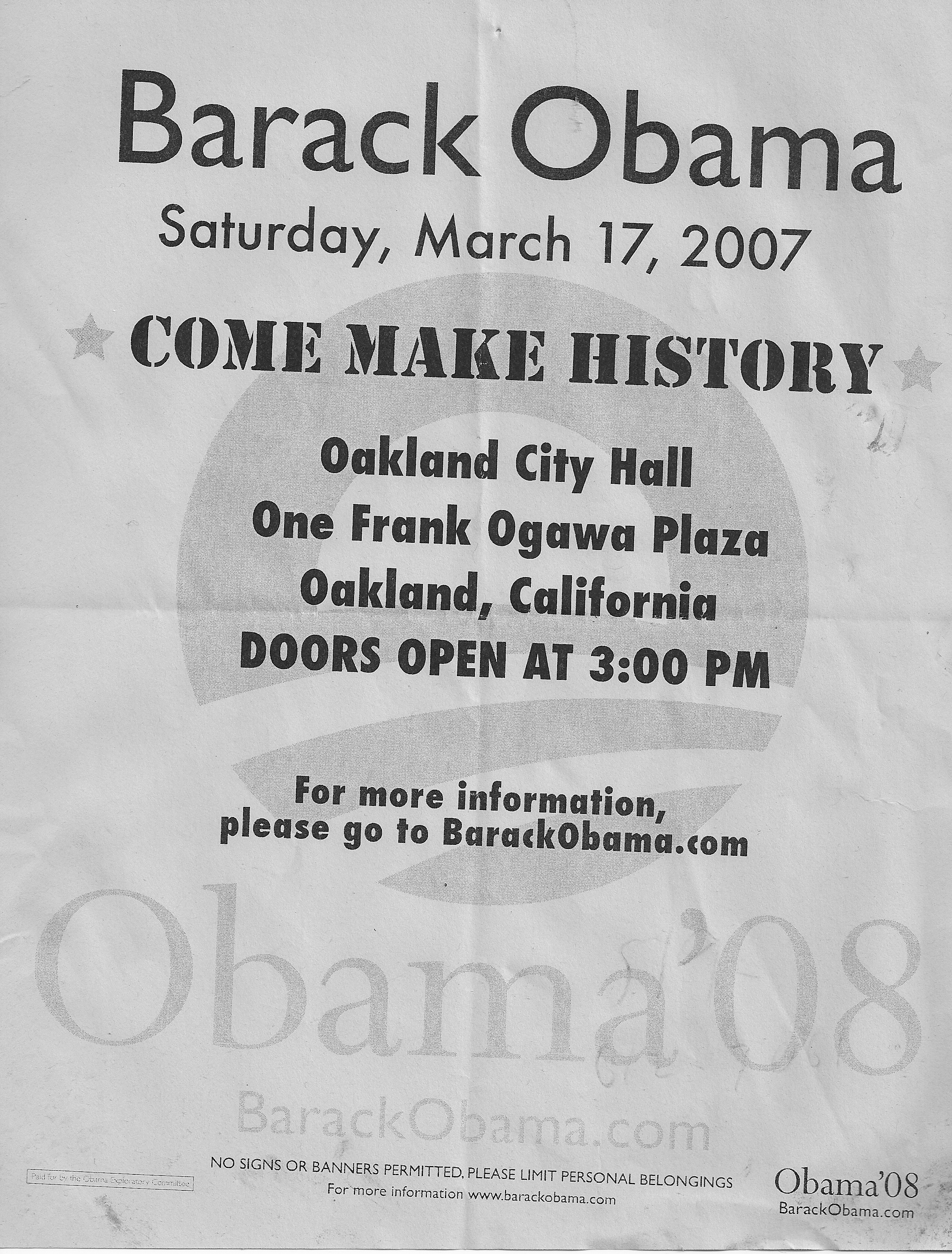
Obama, Three Years Later
The flier reads “Come Make History.” I almost threw it out after making some notes on its blank backside. Instead, I stuck it up on my bedroom wall as a reminder. The flier was for then-presidential candidate Barack Obama on March 17, 2007.
It was three years ago that I got a chance to see Obama in the flesh. I actually couldn’t see him during his speech. My free ticket only let me into the general area of Frank Ogawa Plaza in downtown Oakland, not close enough to get a view of the podium. After the speech, when the crowd was beginning to leave, I was able to get a closer look and saw Obama walking about the area in front of City Hall, waving and greeting fans. He was well dressed in his white shirt though he was not wearing a jacket or tie. The mood was relaxed, and everyone was having a good time. A number of people had signs that placed an apostrophe between the O and the B in his name (O’ Bama) since it was St. Patrick’s Day. I had enjoyed the speech, though I thought he could never win the nomination, let alone the general election. Well, I never said I had psychic powers.
Like many, I was concerned about his lack of experience in electoral politics, but, as I studied his positions on his web site and listened to his speeches, I realized that he had correctly identified the three biggest issues our economy faces today.
The first he identified is health care. There are many of us who can’t find affordable health insurance, especially as we get older. I am currently paying for coverage out of my own pocket with $900 yearly deductible. I failed to meet the deductible last year so much of my few medical expenses came out of my pocket. At the end of this month my monthly premium is going up $150. My original monthly payment was $249, so this latest increase will bring it to $421. The reason for the increase is that I will be turning 60 years old. Thanks for the birthday present Blue Shield.
Why can’t I buy into Medicare? I would be willing to pay what I am paying now. At least, I wouldn’t have to worry about losing it. What happened to the thousands of dollars my employers and I paid for group insurance when I was young and healthy? They went into the pockets of the insurance companies and stayed there after I was no longer covered.
The second critical issue identified by the Obama campaign is energy and climate change. According to military analysts, climate change is a major threat to our national security. Wars over dwindling resources will be common if we allow global temperatures to rise. Millions of people will be forced out of their homes as the result of the loss of arable land, coastal flooding from rising seas, and the lack of clean, drinking water.
We have spent billions to fight wars in order to maintain our supply of oil. Then, we have wasted that oil on an inefficient transportation system and throwaway plastics. We have let our public transportation systems rot, making more people dependent on cars to get to work. Jobs have left our cities to places where parking spaces are plentiful and cheap. People in cities who don’t have cars end up with no jobs either. As the finite supply of oil gets used up, the cost of filling gas tanks goes up, too. Meanwhile, the plastics we have been throwing away have been floating in and killing our oceans.
The third is education. As the old bumper sticker read, “If you think education is expensive, try ignorance.” We have defunded our schools, especially in those cities where jobs and public transportation are disappearing. Our young people have turned to crime to make a living. Then we spend even more money keeping them in prison than it would have cost to educate them for good paying jobs.
Yes, there are good jobs available, even in this bad economy. The problem is that people need education and vocational training to fill them. We wouldn’t need to import high tech workers from India if we just invested in training our own workforce.
Investing in our cities would save us money when people can get to work on the local bus. Taxes from expanded economic development would fund education. Young people would not need to sell drugs to earn money.
So I find it ironic when people complain that Obama should forget about health care, energy, climate change, and education and work on the economy instead. The only way we can fix our economy and get people back into good, sustainable employment is by dealing with those critical issues.
Last night, I was riding my bicycle to a meeting along one of my favorite routes when I encountered a huge pickup truck parked by the curb. A hand-painted sign hung across the entire width of the tailgate with the message that Obama has failed to deliver on his promises on jobs and the economy while mocking his hope and change slogans. The truck looked like it was almost brand new, and I figured the owner was probably not from around here (Berkeley). As I passed by the cab, I looked in to see a middle-aged white man with a crewcut in the driver’s seat. He saw me starring at him and said, “Worst President ever.” I just kept riding. I wasn’t out for a fight. I am sure that his intent was to drive his big pickup into the People’s Republic to provoke a confrontation.
I guess if I was that guy in the pickup truck, paying over three dollars for a gallon of gasoline, I would be angry, too. I would hate Obama for not giving me cheap gas and more tax cuts. Sorry middle-aged, white guy in the big pickup truck. Cheap gas and tax cuts got us into this mess. We have failed to invest in our infrastructure, and, worse, we have failed to invest in our citizens’ health and education. Don’t you remember your George W. Bush and Ronald Reagan? Don’t you remember the bills you have to pay for even yesterday?
Happy St. Patrick’s Day.
A different take on climate change
I have just finished reading an entertaining book with a different look at the issue of climate change. Greg Craven looks at it as a risk analysis problem with his book What’s the Worst That Could Happen? After reading it, I have been checking out his videos on his website, such as the one above.
http://www.gregcraven.org
http://www.manpollo.org
The question according to Craven is not whether global climate will happen or not, but what is the best course of action, given that we are not certain if it will happen or not. He explains it thoroughly in both the book and videos so I won’t detail that here. I will point out some important ideas he brings up to consider.
The most important thing is I don’t need to be an expert to act on the information I have to influence policy. All I have to know is the cost of acting or not acting given the probability that we humans are changing the climate or not.
Next is the recognition that scientists can be wrong. In fact, science is built on scientists being wrong and acknowledging that they are never certain. When a scientist publishes in a peer reviewed paper and others find mistakes that means the scientific process is working. Craven tells us that scientists don’t offer up their theories to be proven but to be disproven. If mistakes are found, the theory is fixed or thrown out completely. If a respected scientific journal publishes a paper that turns out be wrong, it will print a retraction to maintain its credibility. Finding those mistakes moves us closer to the truth.
Craven has a tool we can use to rank the sources by credibility. Does the source have experience in the subject? Do they know what they are talking about? Does the source have a bias? Are they able to be fair? Craven says we should always be aware of our confirmation biases, that is only using evidence that agrees with what we believe. We can rate sources so that the highest on the scale are the ones with the most expertise and the least bias. In fact, he rates sources higher if they argue against their normal biases. For example, we would expect Greenpeace to support the reduction of greenhouse gas emissions. What if a major oil company comes out in support of the reduction? Oil companies are usually on the other side of environmental issues than organizations like Greenpeace and the Sierra Club. If a company or organization argues against its usual bias, that is significant.
In the end, science is imperfect, but it has a better track record than other methods of figuring out how things work. When it comes to climate change, we don’t have time to wait for more perfect information. To delay means we have chosen inaction, and, if the scientists are right, we don’t have time to delay. In this climate experiment, Craven points out, we are in the test tube.
Closure
At my last visit to Costco, I bought a bucket of kitty litter. We’ve had two cats for many years now, but I never had to buy litter before. They always stayed outside and went to the bathroom in the backyard. That was because we had dogs in the house, and the cats couldn’t stand being in the same house with the dogs. For most of the time we have owned this house, going on three decades, we have had dogs. I wrote about our older daughter’s dog Kahvi in a story on my website The Dog That Ate Stalin. In the last several years we lost two dogs to cancer. For me, the loss of Audrey was the hardest, even though she was our younger daughter’s dog, not mine. Still, I had gotten quite close to Audrey who started out her life with intestinal problems that nearly killed her. After a couple of operations, she lived quite well until cancer claimed her unexpectedly at age 8. Now, with no dogs in the house, the cats have decided to come in to spend the cold, rainy nights. One of them likes to go on the pantry and bathroom floors. Getting tired of cleaning cat pee and poop off the floor was my motivation to buy the litter and construct a temporary litter box out of cardboard. I am sure I will get a regular box eventually.
At a memorial service a few weeks ago, I spoke to my friends about the time it has taken to find closure over the loss of our pets. I said I didn’t know if I will have another dog again. They are quite expensive, and my income has decreased greatly over the last few years. One spoke in support of pet health insurance, saying it was a good deal. Thinking of it later, I realized it was more than the monetary expense. Pets take a lot of our time as well. I know I could have done a better job training her. She was a pain to take on walks, lunging at other dogs when I had her on the leash. If I decide to have another dog, I would need to consider that time investment, as well.
For about a month after Audrey died, I didn’t feel like doing much. I would miss her nosing my bedroom door open in the middle of the night and plopping herself on my bed with a thud. I would imagine the bed shaking and look over to see if she was there. No, I had to realize, Audrey won’t be jumping on the bed anymore. Now, while watching TV, I will have a cat (or two) on my lap. That is how closure can happen sometimes. One door closes. Another opens.
A few years after my adoptive mother Alice died of breast cancer, I had a vivid dream about her I will never forget. It seemed the two us were in standing in her bedroom, having a normal conversation, nothing out of the ordinary. She started looking through her dresser, trying to find something. I don’t know what. Suddenly, she turned around and gave me a big hug. I felt that hug. It was very powerful, like she could crush me to death with it, but it was intentionally restrained in order to convey her message. When I woke up, I realized what that message was. “Don’t worry about me. I’m OK. Keep going without me.”
I adopted Quakerism as my religious faith, though I confess to being an agnostic. A few Quakers have admitted to me that they are atheists. I don’t know if there is a God, or if there isn’t. I do believe in the possibility of a reality that is greater than what we experience and call reality. I wonder if that hug was my connection to that greater reality and if Alice was sending the message that our existence does not end with death.
I have been wondering if I should write down any special instructions for my own memorial. The Quaker Meeting I am a member of, Strawberry Creek, has been encouraging its members to write up a final affairs document that the Meeting can keep on file. I guess the big question for me is where the memorial would be held. Strawberry Creek does not own a meetinghouse. We rent space in a school. I’d rather it not be held there. Either Berkeley Friends Meeting or Berkeley Friends Church would be good locations, as both are accessible by public transit.
At one Meeting workshop on the subject of final affairs, we discussed what kind of music, if any, we would want for our memorial meetings. I asked if it would be in bad taste to request Always Look on the Bright Side of Life from LIfe of Brian. A good memorial should include humor. Eric Idle’s song would lighten things up a bit. Or I could choose the Kinks’ Celluloid Heroes. “Celluloid Heroes never feel any pain, and Celluloid Heroes never really die,” wrote Ray Davies. The actors we see in the movies have transcended death. Their art keeps them alive. That would be inspiring. When I heard Patti Smith sing Peaceable Kingdom, the song she wrote for Rachel Corrie, I immediately thought it would be perfect for a Quaker memorial meeting.
The problem with song requests is that it would take away from the spontaneity of silent worship. Maybe the songs could be sung at the reception afterward. The memorial itself should leave plenty of room for messages. If I could deliver a message to that memorial meeting it would be “Don’t worry about me. I’m OK. For those who remember, loved ones still live.”
May the memories of those who have left us bring us the closure we seek.
DADT- It comes down to integrity
Thinking about the Don’t Ask, Don’t Tell debate reminds me of the old comic strip Andy Capp. Andy was Archie Bunker before there was an Archie Bunker; a drinking, smoking, gambling bigot who regularly beat up his wife. In our current terminology, you could say he was not P.C. In one strip, Andy was hanging out at his local pub, and the bartender introduced him to a young man applying for a job. “You don’t mind if he wears a beard?” asked the bartender. “Not at all,” answered Capp, “as long as he doesn’t wear it at work.”
So the argument continues about gays and lesbians who want to serve in the military while being open about their sexual orientation. I heard one serviceman say on a radio talk show that he had nothing against gay people as long as they were not gay on the job. Even if it was possible for our service people to leave their “gay” at home before coming to work, it gets even more difficult when they eat, sleep, and work at the same place.
Football player Garrison Hearst knew he wasn’t being P.C. when he asked about another NFL player’s coming out. “I don’t want any faggots on my team,” the then 49er told the Fresno Bee in 2002. “I know this might not be what people want to hear, but that’s a punk. I don’t want any faggots in this locker room.”
So what is the difference between being closeted in the military or on the football team and having one’s sexual orientation known to the world? We gay men have stood next to countless heterosexual men at urinals. We have undressed and showered in the same locker rooms. The strangers we encounter in these public environments know no more about our sexual orientation than we know about theirs. Somehow, all this is supposed to change when you know the person next to you is gay.
Have I ever been in a locker room with another man I found attractive? Of course, though most of the men I have seen naked there haven’t interested me at all. In every situation, I have been able to control myself, and I believe we can expect the same from the men and women who share the same barracks. So don’t kick people out of the military because of who they are instead of what they do. If someone behaves badly, he or she should face the consequences. It shouldn’t matter if that person is homo or hetero.
As a Quaker, I am opposed to war and militarism. However, I do not find it a contradiction to support the right of lesbians and gay men to join the armed forces. In addition to being pacifists, Quakers have a testimony on integrity. We believe we must be honest in all our relations with others. A good description of what integrity means to Quakers can be found in Pacific Yearly Meeting’s Faith and Practice:
The testimony of integrity calls us to wholeness; it is the whole of life open to Truth.When lives are centered in the Spirit, beliefs and actions are congruent, and words are dependable. As we achieve wholeness in ourselves, we are better able to heal the conflict and fragmentation in our community and in the world.
Integrity is a demanding discipline.We are challenged by cultural values and pressures to conform. Integrity requires that we be fully responsible for our actions. Living with integrity requires living a life of reflection, living in consistency with our beliefs and testimonies, and doing so regardless of personal consequences. Not least, it calls for a single standard of truth. From the beginning, Friends have held to this standard, and have often witnessed against the mainstream. When they suffered in consequence of their witness against secular order, their integration of belief and practice upheld them in adversity.
A person living in the closet is not being honest with himself or others. Chairman of the Joint Chiefs of Staff Admiral Mike Mullen agrees. In his testimony before the Senate Armed Services Committee he said, “For me, it comes down to integrity — theirs as individuals and ours as an institution.”
Our wholeness as human beings include our sexual nature. Science is confirming what we gay people have known in our hearts from the beginning. Being gay is not a choice. More importantly, being gay is not an affliction or a dysfunction. So don’t tell me that, if I come to work for you, I must leave my homosexuality or my integrity at home.
Anna Campbell’s Stories
If there is a gay gene, I know mine is defective.
Some examples:
1. I have no gaydar. George Takei came out of the closet? I never saw that one coming. Seriously!
2. I have no fashion or decorating sense. If it is comfortable and it fits, I’ll wear it. If not, forget it.
3. I was never really hot for Judy Garland. I did like Barbra Streisand when I was a teenager, so I guess I am not totally defective. Then again, I’d dump both of them for my middle school gym teacher.
4. I never got into watching soap operas.
The last one amazes me the most because I should have inherited the soap opera gene from my mother. She was absolutely hooked and would stop everything she was doing to watch her “stories.” She never missed an episode of Search for Tomorrow and The Guiding Light. After that came As the World Turns. She didn’t watch that as religiously, but close. Now, two of those soaps are canceled according to the news from the past week. Guiding Light was canceled a few years ago. World will end this coming year (the show, not the planet). If Mom wasn’t already dead, the news might have killed her. Hopefully, wherever she is now has reruns.
The only thing I can remember about Search for Tomorrow and The Guiding Light was that when they were first on TV they were only 15 minutes long each and broadcast during the same half hour. I found that odd, but that was how they were scheduled when they came to TV from radio. Both later expanded half hour shows.
Mom found that ironing clothes was a good way to multitask. She positioned the ironing board in front of the TV so she could watch her stories while getting some housework done. During Christmas vacation, if the weather was too lousy to play outside, I would play with my toys on the floor in the living room, between the ironing board and the TV.
It was during one Christmas vacation that I witnessed a live TV blooper moment. I can’t remember when or on what show. Mom’s stories, like many TV shows, were live then. If mistakes happened, they went out over the air. The scene was a married couple standing in front of a huge, beautifully decorated Christmas tree. They were having some intense conversation about their relationship that I really wasn’t paying attention to. Maybe the only thing that caught my attention was the Christmas tree. Both stepped away from the tree, but stopped to face each other and continue their conversation. The camera zoomed in so that only their heads and upper torsos were on screen. Suddenly a loud crashing sound interrupted their dialogue. It was the sound of a thousand Christmas balls smashing to the floor. Both actors immediately turned and faced the direction where the Christmas tree was supposed to be. Then, just as quickly, both turned to face each other and continued to read their lines as if nothing had happened. When the scene finished, the show went to commercials.
Since those days, the soaps have gotten more steamy. Yes, there are hunks for the suburban housewives and gay men. There are also hot women to attract an increasing number of heterosexual male viewers. It is still not enough to get me to invest that much time out of my short life. If I am going to commit my life to a TV show, it better be good. On that front there is hope. Last October, I decided to watch an episode of Glee. I haven’t missed an episode since and can hardly wait for the new season in spring. I think hearing Rachel sing Streisand sealed the deal for me. Now I don’t know if you could call Glee a soap opera. It’s close enough for me. I believe I could use that to perform a bit of gay gene reparative therapy.
If you think your Mac is safe from viruses read this
My Macintosh PowerBook was infected by a virus. I can’t say I wasn’t warned. Just a few weeks ago, a friend invited me to a luncheon at the Berkeley City Club, featuring a lecture by an expert on computer security. He told me quite bluntly that Macs are vulnerable to viruses, and I was foolish to not have an anti-virus program. I guess I will take his advice, I said to myself. Then again, this old G4 is near the end of its lifecycle. I should be investing in a new MacBook and buying protection then. My money or my digital life? Like Jack Benny, I wanted to think it over.
When I bought the G4, it did come with a McAfee subscription. Every morning for several years, the program started up on schedule, scanned the entire system, and found nothing. I did not get any notice to renew the subscription. I just noticed one day that the program had stopped scanning. I decided it was not worth the effort to renew. Besides, I make sure I download all the software updates that come on a weekly basis. Sometimes, they are security updates. Most of the time the update is for iTunes, a program I would probably use more if I had an iPod, but I don’t.
I am always careful on the Internet. I never click a link in an e-mail, but go to my browser and type the URL of the site instead. Then last Friday, an odd thing happened. I have my Firefox browser set to sign on automatically to Twitter and Facebook. This time, I was not logged in to Facebook. No problem. I will just log back in. But when Facebook opened, most of the page was blank. There were no news feeds or status updates. Only the tool bar at the top of the page was showing. I thought the site might be down or having other problems, so I clicked the links on the toolbar to see if other parts of Facebook were affected. Finally I got a home page, and continued my work, thinking nothing more of it.
The next morning, I opened my e-mail to disturbing news. One of my friends told me I was sending spam messages to his wall. He had to defriend me because each message sent an alert to his cell phone. I logged on and discovered that “I” had posted to a dozen of my friends’ walls. They were links to videos that, according to “me,” were funny or pornographic or funny and pornographic. I manually deleted each of the posts. Some of my friends’ walls had multiple posts, others only had one. Then I quickly changed the password, shut down my machine, and unplugged my Ethernet cable until I was able to make sure I had fixed the problem.
After getting off work on Saturday, I bought Norton Internet Security and had it check my entire system that night. It ran all night while I slept. In the morning, Norton had found two viruses, both called Trojan.ByteVerify. The definitions page describes it as a PC virus with a low threat level. I do not know if this was the virus behind my Facebook hack or if it was a treat to either my computer or other Windows computers on the Internet. It is better off of my machine, so I am glad I bought the program. In addition, there is now a bar at the top of my Safari and Firefox browsers, telling me if I can trust the site I have loaded up. That definitely would have kept me out of the trouble I got into with Facebook. I figure that somehow I was taken to a bogus site where I foolishly gave up my password. Thankfully, the evil bot did not change the password and lock me out of my Facebook page. It could have been worse.
“But Macs aren’t supposed to get viruses” came the responses to my tweets about the hack. Well, guess again. Take my advice or learn the hard way.
The Day Berkeley Seceded from the U.S.
On election night 1980 people on the west coast were learning that Ronald Reagan would be their next president even before their local polls had closed. Here in Berkeley, a large number of people, mostly students, refused to take that news sitting down. From our flat near the corner of Ashby and Telegraph, we heard the roar of outraged residents marching in the street. We naturally came out and joined them. The growing crowd wound its way around the South Campus area, shouting its outrage that their country could be so stupid. We had endured eight years of Reagan as governor. How could our country accept this amateur as its leader? A nervous Berkeley police force quickly set up an escort for the unruly crowd. The presence of a line of police cars attempting to lead the march was not welcome. It soon became a game for us to change direction quickly and keep the police guessing where we were headed. At one point, the march crossed to the west side of Grove Street (now Martin Luther King Jr. Way), which was considered a protest milestone. After several hours of chants and jeers, the crowd got tired and returned to their homes.
However, after all the marching and chanting, Ronald Reagan was still our next president. The frustration and anger lingered. I met an old woman in front of the post office who was depressed that her life of political activism seemed in vain. I could imagine that she was radicalized, as many were, during the great depression. After working for social and economic justice, she was now in the last years of her life, watching the country headed in the wrong direction.
Not long after that, an unusual concert was held in the city. The Veterans Memorial Building on Center Street had become a popular venue for politically-aware music and comedy. The main auditorium was a great place to listen and dance to live bands. Downstairs acoustic folkies and comedians played to more intimate groups. The stairways were crowded with fans filing past each other to sample the offerings on both floors. On one particular night, the Sisters of Perpetual indulgence of San Francisco came across the Bay to engage in a plot of political subversion. The City of Berkeley would secede from the United States. In a prominent location, a declaration of independence was placed on a table where we could all get a chance of add our names. Everyone in my household signed the declaration.
It would be hypocritical of me to criticize the right-wingers today that are now calling for secession. I am sure they have the same distain for Obama that we had for Reagan several decades ago. Like us, they had assumed that history would continue to move in their direction. Reagan brought an end to New Deal-style of government. The country would end its dependence on tax-financed social programs for the poor, government regulations on businesses, and labor unions for workers. America would bring peace to the world through military intervention anytime and anywhere it determined was needed. They eventually convinced enough Democrats to help them deregulate banks and support regime change in Iraq. Now we know where that led.
The right is bitter that we have a Democrat back in the White House, and more than a few are especially bitter that the new president is black. While the Senate addressed health care reform this past weekend, pundit Dick Morris was very active on his Twitter account, posting the following Tweets:
Would anyone like to play a game? Predict what states will secede from the union and in what order? Texas, Alaska, Connecticut.
BREAKING! Texas, Louisiana, Arkansas, Oklahoma, Connecticut will soon announce their intentions to seceed (sic) from the union.
LET’S HIT THE GOVERNMENT WHERE IT HURTS! SECEDE! http://www.secession.net
It is our DUTY to protect and defend the CONSTITUTION at all costs… that’s why we have guns, folks!
Obama really gives you a good idea just how evil Satan is. Scary stuff
In previous tweets, Morris has speculated that the shooting at Fort Hood was a plot by Obama to divert attention from the health care debate. At least having Obama in office gives Morris someone else to hate beside Hillary and Bill Clinton.
SECESSION.NET advocates for what it calls “community based secession” and for “the primary political right of the individual and of political communities” to secede. This libertarian web site wants to appeal to both the left and right with buttons calling for both blue counties and red counties to secede. A couple of quotes from the website:
“The time has come to recognize that the great nation state “experiment” of the last five hundred years has failed. The time has come for humans to launch new experiments, ones based on past experience as well as new ideas and technology. The time has come to identify principles and strategies, and initiate educational and action campaigns, to support the world’s people as they seek true freedom, true peace and true justice.”
“Secession of individuals and communities does not have to mean war and violence. It should be a natural evolutionary feature of all political entities. Communities can form networks or confederations, since secession is accepted by both in principle. However, communities will not form “federations” which by definition do not allow secession. We will suggest practical and nonviolent means by which such separation can occur and the kinds of networks and confederations that could be created to replace oppressive nation states.”
This community-based secession is more in line with the Berkeley model that the state-based secession suggested Governor Rick Perry in Texas or by the Alaskan Independence Party that found support from Todd and Sarah Palin. It might be more like the revived movement to create a new state from northern California and southern Oregon that would be called Jefferson. In1975, Ernest Callenbach devised the secession of the northwest section of the U.S. to form Ecotopia, the product of a nonviolent revolution by environmentalists.
There is a certain populist appeal to this community-based secession movement. Berkeley has always been at the forefront of community-based movements. At the height of activism against the Vietnam War we became the first city with its own foreign policy. During the Reagan era, we were among the first cities to declare ourselves a nuclear-free zone. If the country would not get out of the nuclear war business, then we, the people, would do that, community by community. When the United States failed to ratify the Kyoto Treaty, we decided to reduce our own greenhouse emissions in compliance with Kyoto. Again, other cities are following our lead. Maybe the real solution is to secede from our narrow-minded nationalism and join the Planet Earth.
Everything But Marriage, A Tale of Two States
Yes, I am disappointed that marriage equality lost at the polls again, this time in Maine, but I continue to be reluctant to equate the passage of Measure 1 with homophobia. The vote was close, but we should have won. It should have been apparent to everyone that this is a civil rights issue. Obviously, it was not. But we shouldn’t assume that everyone who voted for Measure 1 hates gay people, nor should we label Maine residents as a bunch of ignorant bigots. Yes, in the same election, voters approved a medical marijuana initiative. This is good news for people with HIV/AIDS who use the drug to stimulate their appetites and counter the side effects of chemotherapy. As an environmentalist, I am also happy to see that a measure to reduce taxes on cars was soundly defeated, but that is another issue. The fact that these votes are close is amazing, considering the size of opposition to marriage equality just a decade ago.
Meanwhile, in Washington, voters passed a liberal domestic partners initiative Referendum 71, also know as Everything But Marriage. If anything, we should be concerned about the closeness of that vote, about 52% to 48%. A look at the map of election results shows that the counties who approved the measure are clustered in the northwest area of the state, around the large population centers of Seattle and Tacoma. The more rural areas tended to reject the measure. (In Maine, Portland voters rejected Measure 1 by 73%.) It is in these rural areas where we need to do our work.
The best thing we can continue to do is be out and visible. The more people who know a friend or family member who is gay, the more likely they will become our allies. We need to build on the issues where we have majority support. We now have an anti-hate crimes law, and should soon have repeal of Don’t Ask Don’t Tell, as well as passage of a law against employment discrimination. Finally, we should treat those who disagree with us on marriage with respect. We should have answers for their concerns about the definition of marriage. I have some thoughts in a previous blog entry and welcome comments. If we can get Everything But Marriage now, we can build upon that to achieve our rights in all aspects of public life.
Smears against Jennings. Have they no shame?
The smears against Department of Education’s Kevin Jennings continue. Rep. Steve Smith has gathered 52 other Republican House representatives to sign a letter to President Obama, demanding he fire Jennings. The charge “of ignoring the sexual abuse of a child” by Jennings has been proven false, but that does not deter the letter’s signers. Their real motivation is their assertion that Jennings is “promoting homosexuality and pushing a pro-homosexual agenda in America’s schools…” They continue to lie that young people are recruited into being gay. It is the same lie directed to Governor Schwarzenegger , demanding he veto a bill honoring Harvey Milk as a civil rights pioneer. Somehow, teaching school children about the life of Milk will turn them gay. Conversely, we are asked to assume, if homosexuality is barred from the classroom, all children will grow up heterosexual. Having spent my school years in the fifties and sixties, I know that homosexuality doesn’t go away if people stay silent about it. I grew up with Dick and Jane books, where all parents were heterosexual, and, I might add, white.
When I first read about the campaign against Jennings, I sent the following e-mail to Education Secretary Arne Duncan:
Opponents of Kevin Jennings have sunk to a new low by falsely linking him to NAMBLA, a pedophilia advocacy group. In doing so they also smear Harry Hay by falsely stating Hay was a founder of NANBLA. Hay was correctly praised by Jennings as one of the pioneers of the modern gay rights movement. Hay founded the Mattachine Society and co-founded the Radical Faeries. Hay’s only connection to NAMBLA was in his support for their right to march in gay rights parades.
All of the charges thrown at Mr. Jennings have turned out to be distortions or complete lies. It is clear what is the intent of these organizations. They want to turn back the clock to a time when it was not safe to be a gay, lesbian, or transgender youth. I know from experience, growing up gay in a homophobic society. I wish I had leaders like Kevin Jennings when I was in high school. I thought of suicide in those days and am thankful I never acted on those thoughts. Sadly, too many young people have died, lacking the support of their families, schools, and communities. Our LGBT youth need organizations like GLSEN.
I support Kevin Jennings in his position in the Department of Education’ Safe and Drug-free Schools Program. We must not let anti-gay bullies smear the reputations of well-qualified teachers and administrators.
Thank you.
Governor Schwarzenegger rejected the lies and signed the Harvey Milk bill. President Obama said in his speech to the HRC that he would defend his appointees. Let us hope he stands by his word. The smear campaigns against our gay and lesbian public servants remind me of Joseph Nye Welch’s revulsion to Joe McCarthy’s smear tactics. “You’ve done enough. Have you no sense of decency, sir? At long last, have you left no sense of decency?”
-
Archives
- March 2026 (1)
- July 2024 (1)
- May 2023 (1)
- May 2022 (1)
- September 2021 (1)
- March 2021 (1)
- October 2020 (2)
- September 2020 (1)
- May 2020 (1)
- April 2020 (1)
- March 2020 (2)
- January 2020 (1)
-
Categories
-
RSS
Entries RSS
Comments RSS
 Tomyamaguchi's Weblog