Happy Leap Day 2016
Leap days have a special meaning for me. It was on Leap Day in 1980 when I moved from San Diego to the San Francisco Bay Area. That was 36 years ago or 9 Leap Years ago. As I enter my 66th year of life, I am amazed that I have spent over half of them here in Berkeley.
I was married then with a four-year-old daughter. Life in the progressive town of Ocean Beach had been exciting,but my wife Melissa and I were beginning to feel claustrophobic.What little culture we had then was mostly within those small town limits. We had the Strand Theater for movies, OB People’s Food for grocery shopping, and house party fundraisers for various political causes. That was a good thing, too, as Proposition 13 had decimated the local bus system. The bus to Ocean Beach stopped running at 8:30 pm, so we could forget going downtown for nighttime events.
Transportation was becoming a major focus of my political activism. The first gas shortage caught me dependent on a car to get to work. I switched to a job that allowed me to commute by bike. It was a long commute, but the ride got me into excellent physical shape. It was that love of cycling that brought me to friendship with Bob Berry, a former a native of OB who had moved to Berkeley to attend UC. Bob was living without a car. When we met, he told me of his commute to work at a freight airline based at SFO. Working graveyard shift, Bob took his bike on BART to Daly City station, which was then at the end of the San Francisco line. He then biked to SFO. The next morning, he loaded his bike on one of the airline’s DC3s, flying from SFO to Oakland airport. Then he would ride to the Coliseum BART station. If he got there early enough, that is before morning commute hours, he would be able to take his bike on BART. If not, he would have to ride back to Berkeley by bike.
After several visits to see Bob in Berkeley, we decided that Berkeley was the place for us. At the end of 1979, I had finished a full time job which was my first as a political organizer. Bill Press had left Governor Jerry Brown’s administration after failing to get the legislature to pass an oil profits tax that would fund public transit and alternative fuel research. When I read that Press was trying to qualify the tax as a ballot initiative, I signed on as a signature gatherer. The Tax Big Oil initiative did get enough signatures to qualify for the ballot, though it failed to pass in the following election. The experience did succeed in firing me up to engage in more bike and transit activism. I was ready for Berkeley.
So it was on the early morning of February, 29, 1980, that we loaded up our small pickup truck and drove all day. We arrived in the Bay Area that evening. My daughter Dharma later told me that she did not know we were actually moving to a new home. She thought we were going to her grandparents house and was confused when we passed the exit and kept going.
When we got to Bay Area, Bob took us on a quick cultural tour. First stop was the house where Patty Heart was kidnapped on Benvenue Avenue. We then drove to a house on the north side of the Cal campus, where Bob had heard about a party. When we got there we found that the house was owned by Reverend Sun Myung Moon’s Unification Church. Realizing we had ended up at a Moonie party, we left quickly.
Our first home was an apartment in North Oakland. Bob had a friend who was moving out and still had one last month of paid rent. We used up her last month’s rent, hoping that we would be able to stay. That was not to be. We ended up living with Bob in his basement apartment in a South Berkeley Victorian. Space became available in the flat above Bob, and we were able to move out of the cramped basement.
Our roots in the Bay Area became more secure when I was able to find a job in Point Richmond. I was once again a bike commuter. The following year, we bought the house where I am stilling living today. On Leap Day of 1980, I took a leap of faith and am glad I did.
Shoot the Gays?
There has been a lot of commotion about the filing of an initiative in California that calls for killing LGBT people and imprisoning their allies.With $200, Huntington Beach attorney Matt McLaughlin filed the Sodomite Suppression Act, which calls for gays to be shot or killed by some other “convenient method.” Lawyers have pointed out a number of ways the proposed law violates the state and federal constitutions. There have been calls to have Mr. McLaughlin disbarred. Attorney General Kamala Harris has asked the state Supreme Court to relieve her of her duties to prepare a summary and title for the initiative that would have to happen before supporters can print copies of the petition and gather signatures. Lt. Gov Gavin Newsom has blasted out an email expressing his outrage, and by the way, reminds us he is running for governor. While I am happy to have their support, I disagree with Harris’ and Newsom’s efforts. How do I feel about the circulation of the Shoot the Gays petition? I say, “Bring it on!”
I would like to see the folks behind the initiative get their chance to gather the 365,880 valid signatures to qualify for the ballot. The first thing I would do is send a request to Mr. McLaughlin to send me 100 copies. If each copy has space for 10 signatures on a page, I am sure he would be eager to get those 1,000 signatures from me. Then, with petitions in hand, I will head straight to 18th and Castro in San Francisco and set up a table. There, I will invite the voters of California to write on the petitions exactly what they think of Mr. McLaughlin and his Sodomite Suppression Act. Being a believer in free speech, I promise not to censor any of the responses. I will send those “completed” petitions back to Mr. McLaughlin and, of course, ask for another 100 copies.
Even if the Sodomite Suppression Act sees the light of day on the streets of California, I doubt seriously it would becoming to a street corner near me. It takes a lot of money to circulate a petition and usually depends on paid signature gatherers. Initiative backers focus their efforts in places where those efforts will pay off with the most signatures. The plastics industry recently qualified a referendum to overturn the state’s plastic bag ban. I don’t know how many signatures they gathered in the Bay Area, but I did not see any signature gatherers here. I am sure a vast majority of those signatures were obtained from central California and other conservative parts of the state.
When Proposition 8 took away marriage rights from same sex couples, people began to question whether the initiative should be abolished. That was not the first time the California ballot has been used to take away rights. In the November 1964 election, a majority of voters overturned the Rumford Fair Housing Act that had been approved by the legislature and approved a proposition financed by theater owners to ban pay television. As with Prop 8, those propositions were invalidated by the courts.
We learned in history class that the ballot reforms of initiative, referendum, and recall are gifts of the Progressive movement. Progressives were alarmed about the power of the railroads and other big business interests to control the state government and act against the best interests of the people. Through initiatives, people can act when the legislature is inactive. Referendums can repeal unpopular laws enacted by the legislature. Recalls can remove elected officials when the people realize they made a mistake electing them in the first place.
Of the three, the recall has been used the least. The 2003 Gray Davis recall gave the state a ballot with 135 candidates for governor that included a former child actor and a porn actress. As with Prop 8, critics have cited that recall as an example of a dysfunctional process. However, the recall still has a reason to exist. It was an active recall campaign that convinced Bob Filner to resign as mayor of San Diego after being charged with sexual misconduct. While he could have been removed by impeachment, a lengthy trial process would have deprived San Diego of an effective, full time mayor. It should not be easy to recall a public official, but it a tool that should be available when needed.
The initiative process can and should be reformed. One method suggested by a friend is to require that a certain percentage of signatures come from every California county. That means the Shoot the Gays supporters would have to collect signatures from San Francisco and Los Angeles. If most of their signatures came from Kern County and very few from San Francisco, they will fail to make the ballot.
There is one easy way to keep bad propositions off the ballot. When someone approaches you to sign a petition, don’t sign it unless you really understand what the initiative would do and you really want to see it on your ballot. Many initiatives are deceptive and signature gatherers will not tell you what you are really signing, many times because they don’t know themselves. Besides, the time they spend explaining it is less time they have to gather more signatures. To make you feel better, they’ll say, “Just sign it and get it on the ballot. You can still vote against in the election” They assure you that your signature will not count as an endorsement. Of course, when the backers file their petitions with the state, they will boast that all of those signatures show how much support they have.
Many times we sign because we know the gatherer is being paid for each signature. Petitioning has become a creative spare change scheme, a way of giving to a poor person without that change coming from your own pocket. Unfortunately, the money financing the initiative campaign is coming from special interests that are probably working against your interests and the interests of the person asking for your signature. It may be difficult to say no, but there are better ways to give people employment.
Finally, you can keep a lot of petitions off the ballot by doing one simple thing—vote. The number of signatures required to qualify an initiative is based on a percentage of the people who voted in the last general election The more people who vote in a general election, the more signatures the campaigns have to get, and they have go get them within a 3-month time period.
Some of the most satisfying political work I have done involved collecting signatures to get propositions on ballots, both state and local.Sometimes I was paid, and sometimes it was strictly volunteer. When I was paid, it wasn’t much. Sometimes, the campaign was successful, and other times, we fell short. In every case, it was an issue that was really important to me. Even in those losing campaigns, it was an opportunity to meet voters directly and discuss issues they probably would not have considered. I don’t want to abolish the ballot initiative. I want to return it to be what the Progressives intended it to be; a tool to make democracies even more democratic. The judicial branch would continue to protect minorities from being denied their rights, such as Prop 8 or repeal of the Rumford Act. California will certainly survive such silliness as “Shoot the Gays.”
Heads Up-why I support a helmet law for bicyclists
I haven’t blogged in a number of months. I will try to correct that for 2016. I want to share the email I sent earlier to California State Senator Carol Liu, who has introduced a bill to require all adult bicyclists in the state to wear a helmet. Current law requires helmets on children riding bicycles. The bicycling community is divided on the issue.
This is my message to Senator Liu.
Dear Senator Carol Liu:
As a bicyclist, I support your bill, SB 192, to require the wearing of helmets. This is a safety issue that is as important as laws requiring car occupants to wear seat belts. I am disappointed that bicycle advocacy groups that I support would oppose a helmet law. I understand the fear that such a law would send the wrong message on the safety of bike riding. I know because people always express concern for my safety when I tell I am a cyclist. They regard bicycling as too dangerous to do themselves. They scoff when I tell them I have had only a few minor accidents and know more people seriously injured in cars than on bikes. A few of those injured in car accidents had previously expressed concern for my safety on a bike.
There are better ways to convince people that bike riding is safe and to encourage more people to ride. While most accidents between cars and bikes are the fault of the driver, too many accidents occur because of reckless bike riding and many can be prevented if riders adopt defensive driving techniques. Better road design and separated bike lanes can make conditions safer for riders, encouraging more people to take to two wheels on our state’s streets.
A half a century ago, car manufacturers were fighting seat belt laws. They did not want to advertise car safety for fear consumers would steer away from their products. They cited the experience of Ford a decade before, which tried to market its cars as being safer and then suffered by low car sales. Ford gave up on that marketing and went back to selling their models as sex and status symbols. Yet, my parents got the message when they had seat-belts installed in their car years before seat belt laws. They valued the importance of keeping their children safe. I adopted those values as I grew into adulthood. One time, I got into a coworker’s car and immediately buckled my seat belt. She expressed how odd it was to drive in a state where you can get a ticket for not wearing your seat belt. She thought my behavior was being guided only by the fear of a ticket.
When I rediscovered bike riding during the first gas shortage in 1973, I learned the importance of wearing a helmet. It has become natural for me to strap on my helmet before starting my ride. Now that I have learned about climate change, I am even more motivated to ride and encourage more people to ride, as well. I want people to ride and feel safe as they ride. I want them to get on bikes to improve their health with regular physical activity. I want them to reduce air pollution and greenhouse gas emissions. There are laws requiring bicycles to have adequate reflectors and lights at night. We can do more to improve the safety of riding with improvements to bike infrastructure. We can provide better training for riders. I am sure you support those efforts, as well. California bicyclists should support your efforts to improve safety by requiring riders to wear helmets.
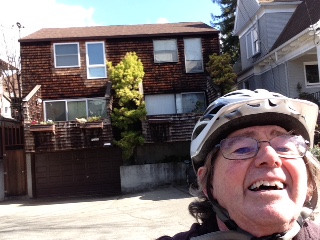
Selfie, wearing my Brain Bucket in Berkeley, CA
Happy to See You
Confession time. I am an unrepentant people watcher. I love watching people: all sizes, all shapes, all sexes, all ages, all colors. I love watching all people, even the proverbial green and blue people. I haven’t seen any blue or green people yet, but if I see any I’ll let you know.
It doesn’t matter if I find the person sexually attractive. In a way, I find all people in a crowd attractive. If they are dancing or walking or running or rolling in wheelchairs or just standing, I like to watch. There is only one thing they have to have in common; they have to be having fun. A smile makes anyone beautiful. People experiencing joy is a beautiful sight to see.
A street fair with food, drink, and live music; a concert or picnic in the park; these are great places to engage in people watching. I know people who say they hate crowds. For me, the more people to watch the better. If I ever go blind, I know that I will find a way to continue to watch people. My only condition for survival in a crowd is access to adequate restrooms. Long lines for the porta-potty is not good when you really have to go. With a clean place to pee when I need it, I am fine. I sit back and watch the passing parade. Or maybe I get up and join the parade.
Of course, I enjoy natural environments, as well, taking the opportunity to escape city life and be in nature, far removed from the civilized environment. I can worship in the cathedral of redwoods, as John Muir once did, or walk along a path far away from roads and parking lots. I found that it doesn’t take far to get to the place where you see no people at all. You just have go go far enough from the nearest parking lot.
For me, the country is a place to escape, to find rest and solitude. The city is a place to live. I negotiate my space with others on a daily basis. I try to mind my manners and share space in the urban environment. I work at acting civilized. I may not always succeed, but I continually try.
Yes, I am a people watcher, and I expect to be one for the rest of my life. If we meet on the street and our eyes connect, my eyes will be saying to yours, “Happy to see you, friend.”
Happy Bike Month
I’ve been a bicycle advocate for a long time now, even before I knew about global warming. I started during the first gas shortage in the early seventies. I bought a ten-speed bike and committed myself to finding a job that did not require me to drive to work. Learning how to ride again as an adult showed me how much out of shape I was. Fortunately, I was still young and, through persistence, was able to attain that goal. By the late seventies, I was riding almost 10 miles one way from my home in Ocean Beach in San Diego to my job in Kearny Mesa, much of it uphill. When I moved to the Bay Area, I was able to maintain that commitment to bicycle commuting, first from Berkeley to Point Richmond and later to jobs within Berkeley. I still ride to work today. In addition, I have made a new commitment to never own another car for the rest of my life. I sold my pickup truck a few years after moving to Berkeley.
Today, if I need a car, I use City CarShare. Most of the time, I can get around on bike and public transit. I am much happier that way. I don’t envy those who are stuck in their cars on crowded freeways. People express fear for my safety on a bike, but I feel much safer than in a car. I have more visibility on a bike, especially when I’m riding in the rain. I usually ride on residential streets where there is less traffic. Yes, I’ve had a few accidents. Fortunately, the injuries have been minor. I know more people who have gotten more messed up in car accidents than by bikes. The exercise I get on a bike keeps me healthy, both physically and mentally. I call it bicycle therapy, and I am thankful to be able to do it every day.
Sitting in long gas lines during the first gas crisis got me realizing the damage that car culture was doing to the environment and society. Our dependence on cars had led to suburban sprawl. Those who could afford to own cars were able to move out of cities. Jobs followed with them. The poor left behind in the cities were stuck with underfunded public transit systems. Without cars, good jobs and housing were out of their reach.
Today, we see a rebirth of our cities. Cars, freeways, and suburbs have lost their charm. I see more people getting on bikes and have more bike lanes to accommodate them. Public transit has improved as ridership has increased. The challenge now is allow more growth in cities without forcing poor people out through gentrification.
Global warming continues to be a challenge, too. Bicycles alone won’t solve the problem, but bicycles can help a lot. A lot more people could ride that are not riding now. They would ride if they felt safe on the road with other traffic. They would ride if the places they want or need to go are close enough to get to by bike. And they would ride if they realized how fun it is, as well as being a lot cheaper for getting exercise than a yearly gym membership. I would still be a bike advocate, even if there was no global warming. Global warming adds another reason to the list.
This Thursday will be the twentieth annual Bike to Work Day in the Bay Area. I will celebrate by volunteering at the North Berkeley BART station. Maybe, we’ll see you there, 7:00 am to 9:00 am. Have a happy Bike Month.
Happy Earth Day. Tweet for the Climate
On Earth Day of 2012 I decided to tweet at least once per day on the issue of climate change. I committed myself to do that until the November election. I was able to keep that commitment, though I did include retweets in that count. My decision was based on the concern that climate change was again being ignored by the candidates and the media. Questions about the climate crisis were being left out of debates. I wanted to do something that would start that conversation on the climate and hoped that people who read my climate tweets would bring these questions directly to the candidates who were asking for their votes. I have no illusions that it made much of a difference, but it was still worth doing. At least, it was better than doing nothing. That is why I am doing it again.
It is Earth Day again on another election year. Activists are concerned about the potential turnout for the November election. The Democratic Party’s hopes for regaining the House are fading, and they face the real possibility of losing the Senate. For people concerned about the climate, this is very troubling. Democrats have been willing to address the issue, while Republicans have been in denial that humans are responsible for global warming. Republicans want to focus on repealing Obamacare and cutting government spending. Democrats are nervous about advocating anything that looks like a tax increase. The most vulnerable Democrats in the Senate are from conservative states that rely on fossil fuels for their economy, such as Alaska and Louisiana. The prospect of passing meaningful legislation does not look good for the near future.
Meanwhile, the media continues to focus who will be running for president in 2016. The speculation started as soon as the 2012 election was over. If stories on Benghazi and the closing of the George Washington Bridge have received so much press attention, it is because of their connection to potential presidential candidates. It becomes too easy to forget there is a national election this year with every House seat and one third of the Senate seats on the ballot. The winners of those races will be determining what legislation gets passed or doesn’t get passed during the next two years.
Climate legislation is caught up in the current polarization of our political parties. Once upon a time, we had liberal and moderate wings in both parties. Today, we are dependent on super majorities for one party to get any legislation passed, being unable to receive even one vote from the minority party. As we celebrate passage of the fiftieth anniversary of the 1964 Civil Rights Act, we are reminded that it took both Democrats and Republicans to get that bill to Lyndon Johnson’s desk. Conservative Democrats in the South wouldn’t support it, so it passed with the support of liberal and moderate Republicans.
When Earth Day was created in 1970, it was celebrated by both Republicans and Democrats. Can we get that bipartisan support for climate legislation today? I believe we can if there is enough of us willing to do something, anything to focus the attention of both the candidates and the media. So starting today, I will be tweeting at least once per pay for the climate. I invite everyone reading this to tweet, as well. If you are really inspired, you can join a group of concerned activists on the Climate March. They started in Long Beach on March 1 and expect to reach Washington, DC in November. Along the way, they are talking to anyone they can about our need to reduce carbon emissions. Right now, they are in Arizona, headed to the New Mexico border. You can follow them on Twitter @ClimateMarch and visit them at climatemarch.org.
The most important part is getting people to vote. Find candidates who are willing to address the climate issue. Support those candidates with your dollars and your vote. Get the word out to everyone you know that their votes count and make sure they show up at the polls in November. I plan to use the hashtag #climatetweet. I don’t know if we can get that to trend on Twitter, but we can try.
Happy Earth Day
Fred Phelps
It is official now that Fred Phelps is dead, and many of us who identify as gay, lesbian, bisexual, transgender, and/or queer are not mourning. His Westboro Baptist Church infuriated us with their “God Hates Fags” signs. While it is easy to cheer Phelps’ death as a victory over discrimination and intolerance, few of us have done more for LGBTQ equality than the Reverend Phelps. The church he led is so full of hatred, his congregation has become a symbol for the true ugliness of homophobia. We see their hypocrisy of professing to be Christians while rejecting everything Jesus Christ taught. If there are any individuals or groups who have brought empathy to the condition of gay people and support for our civil rights, they include Phelps and the folks at Westboro Baptist Church.
Let the Westboro funeral picketers have their first amendment rights. Let them speak and show how irrational their hatred is. Trying to shut them up only gains them sympathy. Phelps has been to our civil rights movement what Lester Maddox, “Bull” Connor, and George Wallace were to the African American civil rights movement in the sixties. Maddox used an ax handle to keep blacks out of his chicken restaurant. Connor used fire hoses to knock people down for simply marching in the street to demand their rights. Wallace stood in the doorway of a public university to prevent blacks from attending. Their actions made them symbols of segregation and Jim Crow. Their use of brute force not only failed to preserve racial segregation, they actually contributed to the success of a movement based in non-violent resistance.
While Phelps and Westboro did not inflict physical violence against us, their message was violent and painful. For that, we should look at Phelps and Westboro no differently than the civil rights leaders of the sixties viewed the segregationists. We start by not hating the hater. If we view racism and hatred as illnesses, we find that people can be cured of this suffering. Before he died, George Wallace would regret his earlier support for segregation. In a public demonstration where Wallace held hands with African Americans he once hated, SCLC President Joseph Lowery, praised him “for coming out of your sickness to meet us. You are a different George Wallace today. We both serve a God who can make the desert bloom. We ask God’s blessing on you.”
Quakers seek God in every person. We know that people do evil things. That does not make them inherently evil. Being a part of God means we are inherently good and only do evil when we suffer from ignorance, fear, and hatred.
I found that coming out of that suffering involves recognizing that those being oppressed are no different than I am. When I was a child in the fifties, I remember playing in the streets on hot, summer nights. Sometimes it was in my own South Jersey neighborhood and sometimes in Philadelphia where many of my father’s relatives lived. In the sixties, I became a fan of Bill Cosby. His comedy described the kids playing in the streets of Philadelphia. I realized that black kids playing in Bill Cosby’s neighborhood were no different than the kids I played with in white neighborhoods. We all played the same games and acted the same way. On TV news, I saw how people were being treated differently because their skin color was different. They were being beaten and jailed for speaking out against their oppression. If a person with a different skin color is otherwise no different than I am, I thought then, why should that person be treated any differently? Why shouldn’t that person have the same rights and freedom I have? I found that growing up in a family that held racist beliefs did not sentence me to holding those harmful beliefs. I could learn to be different.
It is easy to create an enemy. You start by denying that person his or her humanity. I counter that with this thought: start see humans and stop seeing monsters. Humans can do monstrous things, but that doesn’t make them monsters. They are merely frightened, insecure humans, acting defensively in the cause of self preservation. Their biological flight or fight response has been set on fight. They bully to divert attention to the one who is weaker in their group and away from themselves so that others don’t perceive their own fear and weakness.
Was Fred Phelps having a change of heart similar to George Wallace’s? There are reports that he was excommunicated for wanting church members to be nicer to each other. We may never know if he was having a change of heart toward LGBTQ people. Even if it is too late for Fred, it is still not too late for the congregation he left behind. It is not too late for them to realize they are no different than we are. As more of us come out, homophobic people are discovering we include their friends, relatives, and neighbors. Even if they haven’t changed now, we love them just the same.
Noteman
How do I do this? How do I start to write about this? I don’t want to be callous or exploitive of another’s tragedy. How many times have you picked up the newspaper or, now in the 21st century, opened the homepage of the local press and discovered a name there that you knew? If you live long enough in one place and get around town a fair amount, it is only natural that this would happen with increasing frequency. In my case, it was a person who was murdered a week ago and listed as our city’s first homicide. The person was found dead in his home just a few blocks from where I live. This is not unusual. During the three decades I have lived in West Berkeley, a number of people have been killed in my neighborhood. One murder was committed during the night at the intersection near my house.
I met Sylvan Fuselier when I was working for a local nonprofit organization that assisted homeless people with finding employment. By writing this, I am breaching client confidentiality. Sylvan was a client as a homeless person at the time. If that agency was still in business, I could be fired for disclosing that, but we shuttered our doors about a decade ago. I’m not sure what other consequences I could be facing with this story.
Sylvan was one of thousands of people who received services through our agency. I assisted people with writing their resumes and finding job leads on the Internet. In fact, the Nineties were interesting years to be in the job counseling business. Web sites, like Craig’s List, were springing up where jobs could be advertised. Hotmail suddenly gave everyone access to an email account. No longer did you need to subscribe to an ISP or work for a university or company that had an Internet domain, such as .edu or .com. For our clients, it meant being able to have an address on the Internet, giving them a way for employers to contact them.
I never connected Sylvan with the stories of a string of robberies happening in the South Berkeley and North Oakland neighborhoods over a two-year period. I saw the police sketch a number of times in the local press and didn’t see any resemblance to the person who was walking into my office every day. The stories were the same. A man came into a business and handed a note to the person at the cash register. The message was a demand for money. The person didn’t have a gun and was consistently described as being polite. Victims kept remarking how nice he was as he was taking their money. When he was arrested, everyone in our office was as surprised as I was. Then again, why not Sylvan? He was very nice, somewhat quiet, and always polite. In that, he fit Noteman’s description perfectly.
When I saw the article, I immediately emailed the reporter Henry Lee what I remembered and included a link to the 1996 Chronicle story on his arrest. Lee’s response was “Good lord!” and published the update to his story.
A further Google search has not provided information on what happened after his arrest. My memory is that he was found guilty and spent some time in prison. If this is wrong, I will correct it. I saw Sylvan on the street some years later. I told him I remembered him as a client. I was too shy to discuss the Noteman incident. I wish I had now to satisfy my curiosity. i have also wondered if there was a connection to another case in Sacramento. That was the case of Roofman.
The Roofman burglaries took place from 1998 to 2000. Though most occurred in Northern California, Roofman hit locations in 38 states from coast to coast. Frequently, his target location was a McDonald’s restaurant, though he hit other businesses, as well. He would cut a hole in the roof of the fast food restaurant, then would surprise the night crew with a demand for money. Then he locked the staff in the walk-in cooler before getting away with the loot.
Like Sylvan, Jeffery Allen Manchester, was always referred to as polite by his victims. He even let them get their jackets before locking them in the cooler. His story became more bizarre a few years later when he escaped from prison by hiding under a delivery truck and was found later living in an abandoned store in North Carolina. I remember reading at the time of his arrest that he said he was inspired by another robber who was polite to his victims. Was he referring to Noteman? He had been an Army soldier from Concord, so he certainly could have read the local news about Sylvan.
So how do I end this? I guess my questions will never be answered about any connection between Noteman and Roofman. I do feel sad about the loss of a person I once tried to help. In fact, I feel sad whenever I recognize the name of a former client who has failed to gain self sufficiency, even getting into trouble and going to prison. On the other hand, I continue to have people come up to me on the street and thank me for the services of the agency where I used to work. For them, the biggest sadness is that we lost our funding and went out of business. For me, it was an interesting time to meet some very interesting characters. Noteman was one of them.
Prop 8 Revisited
A friend of mine believes that the reason California voters passed a ban on same sex marriage was due to black turnout in the 2008 election. His theory is that black voters who turned out to vote for Barack Obama also voted for Proposition 8, which amended the state constitution to limit marriage to one man and one woman. It is true that many religious conservatives organized in support of Proposition 8 and many many blacks identify themselves as evangelical Christians. Many of those black voters did turn out for Obama. Is it fair to conclude that having a black presidential candidate on the ballot resulted in the loss of marriage equality in California? I don’t agree and believe the answer is not so simple.
There are a number of factors in how Prop 8 won in 2008, and I believe one factor is the number of voters who failed to vote either yes or no. My firsthand experience was as a poll worker in the 2008 general election. I usually work at my neighborhood polling place in West Berkeley. My city, which is in Alameda County, has a worldwide reputation for liberalism, so it is not surprising that Obama won my city and county by a large margin over John McCain. Presidential elections usually have higher turnouts than other elections, and this one was unusually high. A number of voters admitted they had shown up because there was an African American on the ballot. These include voters of various races and ages. With people lining up out the door to vote, I did notice how quickly people moved to and from the voting booths. As with every general election, California voters faced a long ballot, that included numerous state and local candidates, as well as state and local propositions. Prop 8 was among 12 state propositions. I suspected that many people were leaving without voting the full ballot.
After years of hearing the argument my friend was making, I decided to investigate my theory that we could have gotten more votes to defeat Prop 8 if people had taken a few extra minutes on their ballots. I downloaded the Registrar of Voters report on the 2008 results and have uploaded it as a Google Doc to share with you here.
https://drive.google.com/file/d/0B1wfPXUmwFJ5TzZtVW9XcmJzOU0/edit?usp=sharing
I compared four counties with large black populations. These are also generally liberal counties: Alameda, Contra Costa, Los Angeles, and San Francisco. I added up the total of votes cast in both the Prop 8 and presidential races. I put those numbers in a spreadsheet that I am sharing here, also as a Google Doc.
https://docs.google.com/spreadsheet/ccc?key=0AlwfPXUmwFJ5dG5hVHBiRHVGWmVMLW54OU1pdVN5ZUE&usp=sharing
Obama won all four counties by large margins. Prop 8 lost in three counties by large margins and passed in Los Angeles County by a small margin, 50.1% to 49.9%. As I suspected many of those who showed up at the polls failed to cast a vote on Prop 8. Statewide, there was a difference of 159,334. The difference in the four counties I compared was 96,151. These people left the polls leaving the Prop 8 space blank. Why? I am sure many were in a hurry and had to get somewhere, like work or school. Many don’t have time to study all the issues being presented to them and want to reserve their votes for issues where they are more confident. Maybe, people were confused and didn’t want to vote the wrong way. Or maybe they just weren’t interested or interested enough to take a few extra moments to express an opinion. Somehow, over 150K voters who were concerned enough to select a new president decided to take a pass on gay marriage.
Of course, 150K is less than the 600K votes that would have been needed to defeat Prop 8, but it would have been a big chunk. Add to this the number of voters who didn’t vote at all. How many of these gave up waiting in line at their polling place or who failed to send in their vote-by-mail ballots? Could we have motivated those voters to show up for us?
A month after that election, I saw Gus Van Sant’s Milk when it opened in San Francisco. Although it came a month too late, it contained an important lesson that we could have learned from Harvey Milk on how to win gay rights at the ballot box. The ballot proposition then was the Briggs Initiative. In 1978, John Briggs wanted to ban gays and lesbians from working as public school teachers. The premise was to protect children from gay people. Milk correctly identified the issue as having nothing to do with children and everything to do with civil rights. Opponents of the proposition were able to frame the issue as an attempt to deny teachers their civil rights. That was how they were able to defeat Briggs.
That is how we should have been able to frame the argument against Prop 8, as a matter of fairness, equality, and civil rights. Unfortunately, we let proponents in 2008 convince voters it was about protecting school children. Worse, we failed to convince enough people that this was an issue that concerned them. It looks like we have finally learned that lesson because the results of the 2012 elections were much different. When seen as a civil rights issue, people will take the time to vote for what is right.
-
Archives
- March 2026 (1)
- July 2024 (1)
- May 2023 (1)
- May 2022 (1)
- September 2021 (1)
- March 2021 (1)
- October 2020 (2)
- September 2020 (1)
- May 2020 (1)
- April 2020 (1)
- March 2020 (2)
- January 2020 (1)
-
Categories
-
RSS
Entries RSS
Comments RSS
 Tomyamaguchi's Weblog